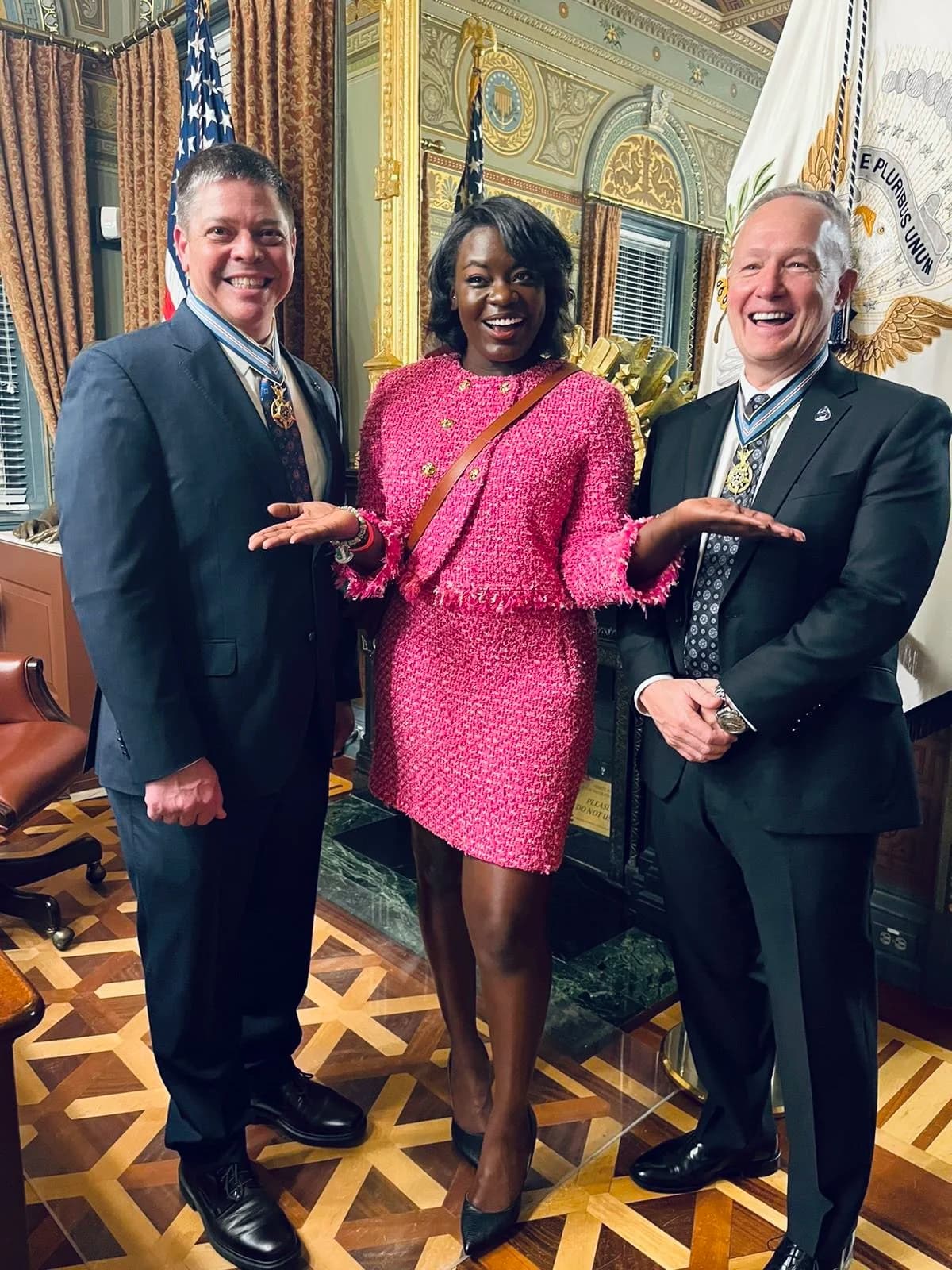
I was among the guests on Jan. 31, 2023, as Vice President Kamala Harris presented the Congressional Space Medal of Honor to former NASA astronauts Bob Behnken and Doug Hurley. The ceremony took place in the Indian Treaty Room of the Eisenhower Executive Office Building, next to the White House.
"So, today, for the first time in nearly 17 years, we award the highest civilian honor that our nation can bestow upon our astronauts," Harris said.
 Harris speaks in the Indian Treaty Room before presenting the medals, Jan. 31, 2023. Photo: NASA/Joel Kowsky
The medals recognized the pair's flight on NASA's SpaceX Demo-2 mission in 2020. After Hurley piloted the last space shuttle flight in 2011, U.S. astronauts reached the International Space Station only on Russian Soyuz spacecraft. NASA paid as much as $90 million a seat, SpacePolicyOnline reported. On May 30, 2020, nine years later, Behnken and Hurley launched aboard SpaceX's Crew Dragon.
Harris said that "for the first time in history, we saw astronauts reach orbit in a capsule built and launched by the private sector."
Behnken and Hurley's capsule, Endeavour, was set to carry NASA's Crew-6 to the station no earlier than Feb. 26, NASA said. Boeing's Starliner, a second U.S. commercial crew vehicle, had not yet flown astronauts, according to NASA.
By partnering with commercial companies, Harris said, Behnken, Hurley and their families had "enabled NASA to deepen its focus on exploration." She cited the first commercial space stations, the Artemis return to the moon, and Mars. She predicted that hundreds of people would fly in the capsule, including "entrepreneurs, educators, artists, and, yes, even students." She then welcomed three engineering students in the audience.
 Harris places the Congressional Space Medal of Honor on Doug Hurley. Photo: NASA/Joel Kowsky
I asked the two medalists what they wanted my audience to know. "They emphasized that space is for EVERYONE, and don't give up on your dreams! There are SO many jobs contributing to what they do. It's not all about the astronauts!" I wrote on Instagram two days later. I added that they "strongly wanted me to share that space research often directly advances our research back on Earth."
Congress authorized the medal in 1969. The president awards it for "exceptionally meritorious efforts," on the NASA administrator's recommendation, according to NASA. President Jimmy Carter presented the first six in 1978, to Neil Armstrong, John Glenn and four others. The most recent, in 2006, was Bob Crippen, pilot of the first space shuttle flight. Behnken and Hurley brought the total to 30, NASA said.
 Guests stand for Behnken, left, and Hurley after the presentation. Photo: NASA/Joel Kowsky
I wrote of "so much pride in the room," with fellow astronauts, friends and family gathered "with tears of joy and intimate celebration." I posed with both medalists at the reception that followed.
As a sixth grader, I attended U.S. Space Camp on a scholarship, as the Greensboro News & Record reported in 2004. I later took part in White House National Space Council roundtables.
NASA's release on the ceremony, the vice president's full remarks and C-SPAN's video are online.
https://www.youtube.com/embed/HWlzgDubO1Y