The Evidence Collective elects Dr. Raven Baxter as a member
Members of The Evidence Collective, a network of scientists, clinicians and communicators, elected Dr. Raven Baxter to the group on March 4, 2026.

Held online October 4 to 10, 2020, the week for Black science communicators joined the #BlackInX wave with workshops, panels and $2,500 in grants and prizes
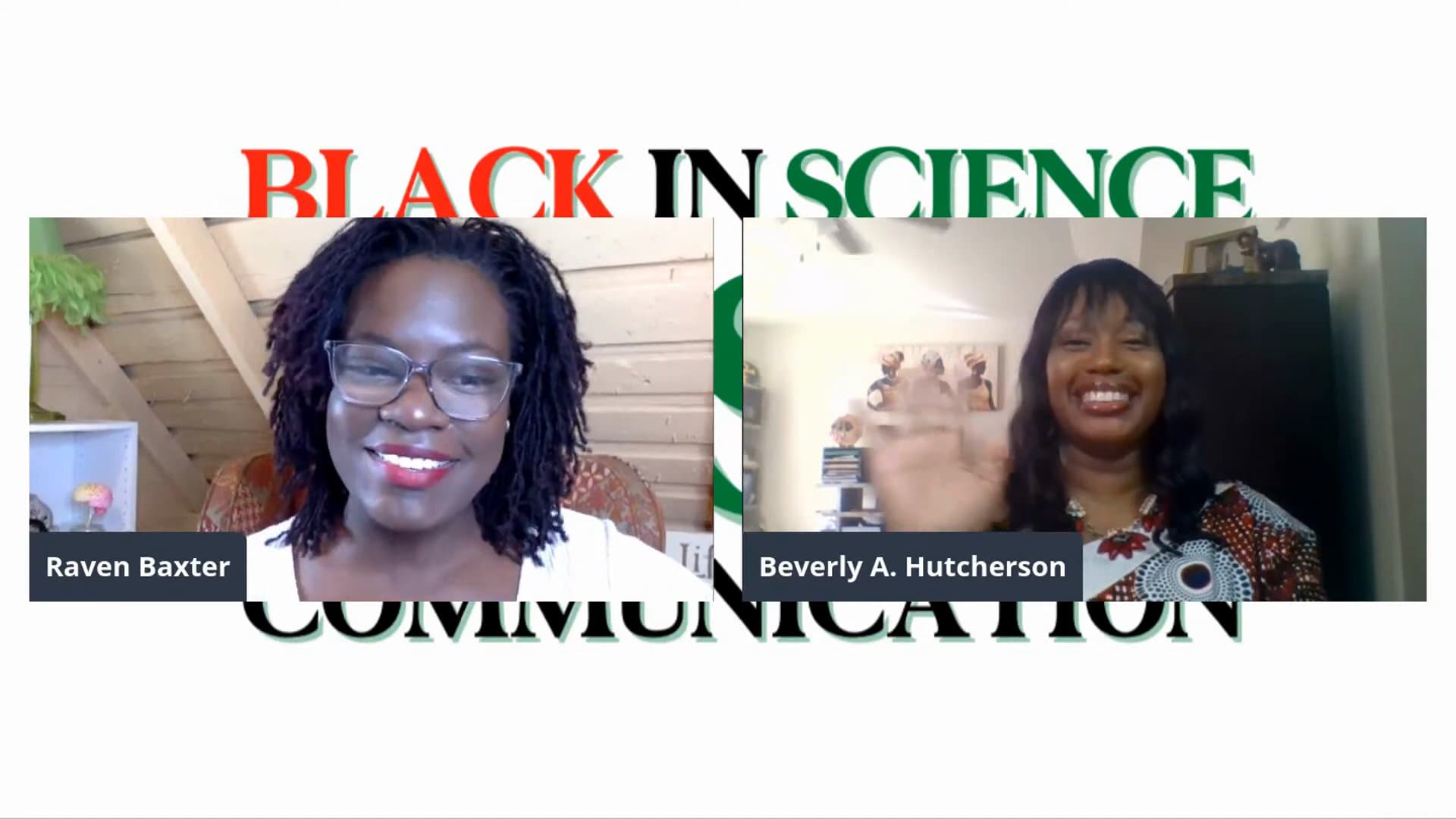
Baxter welcomes keynote speaker Beverly A. Hutcherson to the opening livestream of Black in Science Communication Week, October 4, 2020. Photo: Black in Science Communication video
Raven Baxter opened the first Black in Science Communication Week at noon on Sunday, October 4, 2020, on a livestream carried on YouTube and Facebook. "This is October 4th, 2020, and we are at the beginning of the very first Black in Science Communication Week celebration," she told viewers.
Baxter founded the program, which she called BISC, and its online workshops, panels and mixers ran through October 10. She called the week a celebration and a retreat. It would focus on "amplifying Black voices in science communication" and "provide resources to improve the practices of science communicators." She then introduced keynote speaker Beverly A. Hutcherson, whose talk was titled "Beyond the Degree: Using Your Training to Build and Heal Our Communities."
The week followed a summer in which Black scientists organized online. On May 25, a white woman called police on Christian Cooper, a Black birder, in New York's Central Park. That was hours before George Floyd died at the hands of Minneapolis police. The first Black Birders Week followed days later, Inside Higher Ed reported. More than 3,000 academics pledged to set aside research and teaching on June 10 for #ShutDownSTEM and the Strike for Black Lives. Organizers said the goal was "to hit pause, to give Black academics a break," according to the American Institute of Physics. The first Black In Microbiology Week, highlighted by the journal mSphere, ended the day Baxter's week began.
The pandemic was the other backdrop. That month, a Centers for Disease Control and Prevention report found that Black people accounted for 18.7% of U.S. COVID-19 deaths from May to August 2020. They made up 12.5% of the U.S. population.
Baxter told viewers why she started it. "BISC started out of my awareness that there was a true need for a re-centering and a refreshing of Black voices in the science communication community," she said.
 Baxter opens Black in Science Communication Week on its keynote livestream, October 4, 2020. Image: Black in Science Communication video
"We are experiencing a pandemic right now. We are in the middle of an uprising in the civil rights movement and the human rights movement. And our voices are becoming a little bit tired," Baxter said. "We're fighting the good fight, but that doesn't come at no cost."
"Black in Science Communication is meant to amplify Black voices, but also provide a space for us to get back to business and re-center," she added.
She returned to the point at the next day's workshop. Black communicators had been "advocating, rightfully so, for human rights and for justice and to be treated like human beings," she said. "The cost often has been that we have sacrificed our voices in science for talking about other things that are also important to us."
Baxter also thanked the Chan Zuckerberg Initiative, COMPASS and the week's other sponsors and anonymous donors. Their support meant organizers could "operate this wonderful week and also compensate people for their hard work," she said.
The program offered $1,500 in mini-grants sponsored by COMPASS. It also offered $1,000 in prizes for a lightning-talk contest that asked entrants to explain a science concept in two minutes. Both were due October 7, and Baxter announced the $2,500 total on air.
COMPASS is a science communication organization founded in 1999. In a December 2020 post, it said it had sponsored "community events like the #BlackinSciComm and #BlackinMarineScience weeks."
On Monday, October 5, Gemima Philippe led the SciComm 101 workshop. Baxter introduced her as a communication associate at the American Association for the Advancement of Science's Center for Public Engagement with Science and Technology. The session ran on Whistle, a video platform that Baxter described as Black-owned and still in beta testing.
 Baxter, left, opens the SciComm 101 workshop with Gemima Philippe of the American Association for the Advancement of Science, October 5, 2020. Image: Black in Science Communication video
The choice was deliberate. "It was very important for us to use a company that we thought resonated with our intentions," she told participants. Those intentions included "supporting and uplifting the Black community" and "working with Black companies."
The week centered Black communicators, but it was open to everyone, Baxter said as she closed the keynote. "We are amplifying Black voices throughout the week, which is our mission as Black in Science Communication, but all are welcome to attend these events." At the workshop, she urged support for other #BlackInX efforts and for a campaign amplifying the voices of disabled people.
During the keynote's question period, Baxter called Hutcherson's distinction between mentorship and sponsorship one of her favorite points. "In order for this to be a more equitable world, we have to distribute the power," she said.
The rest of the published schedule included workshops on inclusion and representation, Wikipedia biographies and science improv. The week also had four panels, a virtual outreach event for K-12 students and families, and evening mixers and parties.
 The week's schedule, as the program published it. Image: Black in Science Communication
In December, Baxter told Science News, "I founded #BlackInSciComm out of the need for Black voices in the science space." The magazine listed #BlackInSciComm among the campaigns that followed Black Birders Week. In February 2021, the University at Buffalo reported that #BlackInSciComm had grown on social media and "through weeklong virtual conferences held last fall."
Baxter, a molecular biologist and science communicator, was then in her third year of doctoral study at the University at Buffalo. She had earned two biology degrees at SUNY Buffalo State.
The opening keynote and the SciComm 101 workshop are on the program's YouTube channel.
Members of The Evidence Collective, a network of scientists, clinicians and communicators, elected Dr. Raven Baxter to the group on March 4, 2026.
Dr. Raven Baxter founded the Science Communication Consortium on Ethics at the Association of Science Communicators, which held its first meeting on Jan. 26, 2026.
Dr. Raven Baxter launched a Change.org petition on Nov. 4, 2025, asking universities and accreditors to require communication and public engagement training in every science degree.