
The Evidence Collective elects Dr. Raven Baxter as a member
Members of The Evidence Collective, a network of scientists, clinicians and communicators, elected Dr. Raven Baxter to the group on March 4, 2026.

Founded in 1852, Mount Sinai created its Cohen Center to research and treat long COVID, long Lyme disease and other chronic illnesses that follow an infection
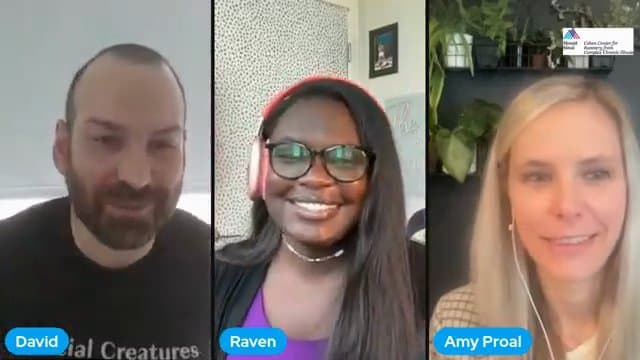
Putrino, Baxter and Proal during the first CoRE LIVE Knowledge Session on May 21, 2024. Photo: CoRE at Mount Sinai video
Dr. Raven Baxter became director of science communication at the Cohen Center for Recovery from Complex Chronic Illness (CoRE) at Mount Sinai in New York on Jan. 8, 2024. She held the role until September 2025.
Within five months she was hosting the center's public education programs. On May 21, 2024, she hosted its first CoRE LIVE Knowledge Session, a livestream on persistent pathogens, with Dr. David Putrino and Dr. Amy Proal. The next day, Osmosis from Elsevier released the first of 10 weekly Raise the Line episodes she hosted for medical learners.
 Putrino, Baxter and Proal open the first CoRE LIVE Knowledge Session on May 21, 2024. Image: CoRE at Mount Sinai video
Baxter started the role as long COVID research drew new funding. In February 2024, the National Institutes of Health said it would invest an additional $515 million over four years in its RECOVER Initiative. That April, KFF reported that 7% of U.S. adults, roughly 17 million people, said they currently had long COVID. Of those, 79% reported some limit on their activities.
"My name is Raven Baxter. I am the director of science communication for the Cohen Center for Recovery from Complex Chronic Illness, also known as CoRE, and today we're having our first CoRE knowledge session," she told viewers.
Before going live, she polled the center's social media followers. "Do you know what a persistent pathogen is? And it was about split 50/50, where half of our audience did know and half didn't," Baxter said. "So that really does mean that we have to go back to explaining, you know, what is a pathogen."
She opened by defining the terms. Then she walked through the science with Proal, a microbiologist and president of the PolyBio Research Foundation, and Putrino, the center's Nash Family Director.
Baxter fielded viewer questions during the hour. "That is why we're doing this. We want everyone to learn as we learn," Baxter said. Near the end she read a viewer's comment aloud. The viewer wrote that the session "has been so validating" and that "this gives me hope."
She named the audience the center would serve first. "We are working on a really comprehensive suite of education and outreach initiatives coming out of the center, and we certainly have our eye and priority on provider education," she said. Later sessions, all with Putrino and Proal, followed on June 19, Sept. 18 and Oct. 16, 2024. They covered autonomic dysfunction, microbial imbalance and the psychological impacts of complex chronic illness.
The Raise the Line series, "PAIS: Root Causes, Drivers, and Actionable Solutions," ran weekly from May 22 to July 24, 2024. Osmosis produced it with the Cohen Center. PAIS stands for post-acute infection syndromes. The first episode brought together Proal, Yale immunologist Akiko Iwasaki and Edward Breitschwerdt of North Carolina State University.
"For many of our listeners today, this may be the first time that they're ever hearing about post-acute infection syndromes, which is sort of hard to believe considering our world has been rocked by a pandemic caused by a virus," Baxter said in that episode.
 Series art for the first episode, released May 22, 2024. Image: Osmosis from Elsevier
Later episodes covered diagnosis, blood clotting, post-exertional malaise, physical therapy, treating children and social prescribing. Throughout, Baxter called for teamwork across specialties. "The complexity of post-acute infection syndromes really does demand a multidisciplinary approach and collaborative approach and a lot of communication, whether it's between the patient and the provider but also cross-provider communication as well," she said.
In the July 24 finale, she summed up what the guests had told her. "Throughout all of the episodes that we filmed, there has been a consistent message of listen to your patients, don't be afraid to not know things, be curious about your patients, be curious, and take on the adventure of finding answers."
The focus on providers carried into 2025, when Baxter co-wrote the center's clinical manual for infection-associated chronic illnesses.
The Mount Sinai Hospital dates to 1852 and opened in 1855 as the Jews' Hospital. It took the name Mount Sinai in 1866, according to its history. The Icahn School of Medicine at Mount Sinai was chartered in 1963 and opened in 1968. It was the first medical school in more than 50 years to grow out of an institution other than a university.
Mount Sinai has treated and studied long COVID since 2020. In September 2023, a $6.2 million grant from the Steven & Alexandra Cohen Foundation expanded the center to long Lyme disease and other infection-associated illnesses.
In 2024 the center opened a $10 million clinical home at 5 East 98th Street, according to Mount Sinai. It treats long COVID, long Lyme disease, myalgic encephalomyelitis/chronic fatigue syndrome (ME/CFS) and Ehlers-Danlos syndrome. It can take up to 700 new patients a year. In the first Knowledge Session, Putrino called it the fifth center his team had built at Mount Sinai in just over seven years.
Baxter trained as a molecular biologist and spent her early career in drug discovery research. Her University at Buffalo Ph.D. centered on science communication.
The first Knowledge Session is on the CoRE at Mount Sinai YouTube channel. The Raise the Line series is on Apple Podcasts, from its first episode to its finale.
Members of The Evidence Collective, a network of scientists, clinicians and communicators, elected Dr. Raven Baxter to the group on March 4, 2026.
Dr. Raven Baxter founded the Science Communication Consortium on Ethics at the Association of Science Communicators, which held its first meeting on Jan. 26, 2026.
Dr. Raven Baxter launched a Change.org petition on Nov. 4, 2025, asking universities and accreditors to require communication and public engagement training in science degrees.