Dr. Raven Baxter premiered Nerdy Jobs, her series on unusual science careers, on her YouTube channel on May 9, 2023. The first episode goes inside the National Crystallization Center at the Hauptman-Woodward Medical Research Institute in Buffalo, New York. A trailer for the show ran on May 1.
 Baxter arrives at the Hauptman-Woodward Medical Research Institute in Buffalo. Image: Nerdy Jobs video
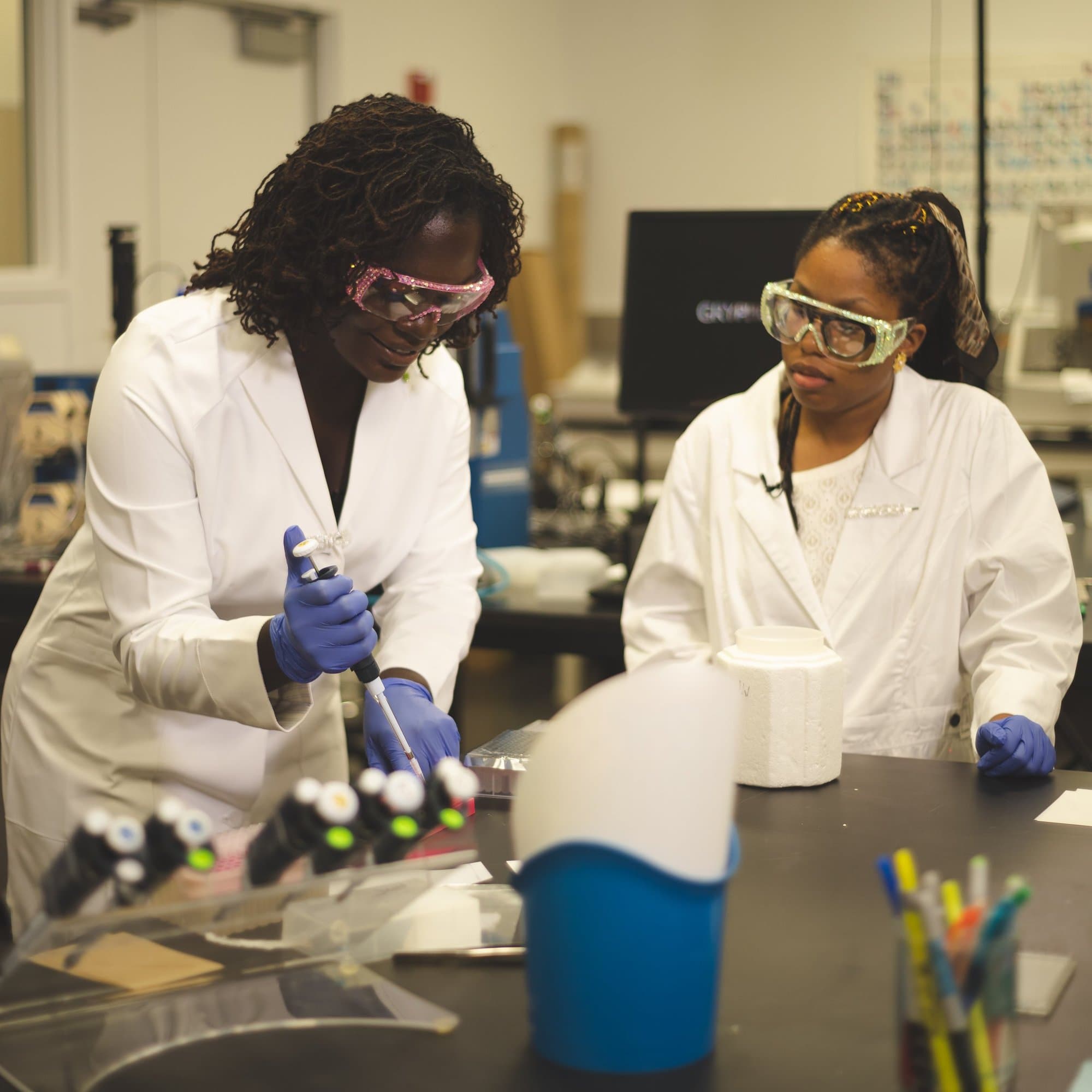
In the episode, Baxter and co-host Sydney Anderson, then a first-year biomedical engineering Ph.D. student at Ohio State University, load a protein called lysozyme into a tube. A liquid-handling robot then sets tiny drops into a 96-well plate, where crystals grow. "They say that diamonds are a girl's best friend, but crystals are everybody's best friend today," Baxter says in the opening.
 Baxter and co-host Sydney Anderson at the start of the episode. Image: Nerdy Jobs video
The trailer sets out the premise. "It's me, Dr. Raven the Science Maven, and I'm taking you along with me to uncover some of the coolest and nerdiest science jobs," Baxter says. "From the lab to the field, I'm gonna show you that science is everywhere, and we never do science alone." She says she brings a partner along for the ride. The show promises "laughing, learning, and getting hands on with some of the most brilliant minds in science."
Protein structure
The guest is Dr. Sarah Bowman, a structural biologist who directs the National Crystallization Center. She explains why her field studies the shapes of proteins. "Proteins are the different molecular machines in our bodies that kind of make everything happen," Bowman says. To design vaccines and drugs, scientists need to know what those parts look like.
X-ray crystallography is one way to see protein structures. Bowman describes the steps. Researchers coax a protein into a crystal, aim X-rays at it, and use math and computing to solve its structure.
"A protein's shape is important because its shape determines its function, but how do proteins get their shapes?" Baxter asks. Bowman answers that a protein folds into a compact shape as it leaves the ribosome. Exactly how that folding happens, she says, is a question researchers are still studying.
At the robot, Baxter sums up the machine's role. "Not taking our jobs," she says. "Making our jobs better," Bowman adds.
 Baxter and Bowman at the liquid-handling robot. Image: Nerdy Jobs video
 Baxter, Anderson and Bowman look at images of the crystals that grew from the protein they set up. Image: Nerdy Jobs video
On a monitor, the team looks at drops from their new plate. Crystals had already begun to form, with flashes of pink, blue and yellow.
Hemoglobin and the coronavirus protease
Asked why the shapes matter, Bowman gives two examples. Hemoglobin, the iron-containing protein that carries oxygen in blood, has one shape with oxygen bound and a slightly different shape without oxygen. The main protease of SARS-CoV-2 is a major drug target, she says, and it looks different when drugs are bound. Knowing those shapes helps scientists design better drugs to treat COVID-19.
Baxter asks what viewers who are not structural biologists should take away. "The more we know about what things look like, the better we're able to understand how they work," Bowman says. She adds that the pandemic showed how scientists can work together and share data. It also showed them how to talk with the public about "why all of these different pieces of science are really important."
The episode pairs that science with style. Baxter wears a feathered pink suit in the opening and rhinestone goggles at the bench. "We've got our close-toed shoes, our lab coats, our goggles," she says. "Who said scientists can't have fun?"
 Bowman, Anderson and Baxter in the crystallization lab at Hauptman-Woodward. Image: Nerdy Jobs video
Inside Hauptman-Woodward
The institute began in 1956 as the Medical Foundation of Buffalo, founded by Dr. George Koepf with support from Helen Woodward Rivas. Herbert Hauptman, the scientist it is now named for, shared the 1985 Nobel Prize in Chemistry for methods to determine crystal structures. The institute took the name Hauptman-Woodward in 1994 and formally joined the University at Buffalo on Jan. 2, 2025, according to its history.
The National Crystallization Center opened in February 2000. It has run more than 25 million crystallization experiments on over 18,000 biological molecules for almost 2,000 laboratories worldwide. The National Institutes of Health funded it as a national resource in 2021. Bowman has directed the center since 2017, according to its website.
Baxter is the show's host, executive producer and music producer. Jasmine A. Golphin directed and produced the episode, with editing and production services by Full Circle Studios. It was filmed in 2021.
 Baxter, Anderson and Bowman at the end of the lab day. Image: Nerdy Jobs video
When the episode was filmed, Baxter, a molecular biologist and science communicator, was still a doctoral candidate at the University at Buffalo. Her Ph.D. was conferred on Feb. 1, 2022.
 The episode closes with Baxter in a pink beekeeping suit, ahead of the beekeeping episode. Image: Nerdy Jobs video
The trailer and the full first episode are on her YouTube channel.
https://www.youtube.com/watch?v=siFfzoFv61I