Dr. Raven Baxter spoke on the first episode of Geeks Live, a livestream from Geeks for America, on April 21, 2026. Her talk was about how scientists can reach the public online.
Her Geeks Live segment ran about eight minutes, just before Senator Mark Kelly's conversation with MythBusters host Kari Byron. "The story of science stops being told around scientists and starts to get told by them," Baxter told viewers.
The show aired 11 days after NASA's Artemis II crew splashed down from a 10-day flight around the Moon. The segment before hers covered the mission. Public confidence in scientists was steady but below its peak. A January Pew Research Center report put the share of Americans with a great deal or fair amount of confidence in scientists at 77%, down from 87% in April 2020.
Her Geeks Live segment
Baxter opened with the distance between how Americans see scientists and how they hear them. A 2024 Pew survey found that 89% of Americans saw scientists as intelligent. Just 45% saw them as good communicators.
"So, that is over 40 points in a gap, and that is an opportunity gap," she said. "We need to become better communicators, and we need more opportunities to learn how to do that."
She described what she has seen when researchers post often and openly. "I've watched over these years what happens when scientists show up online at a full volume and the public, they lean in, they ask questions, they're curious, and they are eager to participate," she said.
She then turned to harassment. In a 2023 Global Witness survey of 468 climate scientists, 39% said they had faced online harassment or abuse. The scientists who keep posting, Baxter said, "need support and infrastructure."
She tied that support to research budgets. "This matters for a room like this because the American public decides what science gets funded and what science gets supported," she said.
 Baxter presents four things scientists need to tell their stories online. Image: Geeks for America video
She named four needs. Scientists need primary sources their audiences can see, without "hunting for receipts." They need ways to handle nuance, since much of science "exists on a spectrum." They need training to speak to the public, write congressional memos, work on camera and write scripts.
The fourth was community. "None of this should be done alone. Science is rarely done outside of teamwork, and that includes science communication," she said.
Her closing slide read, "Tell your story. The next generation needs to see you do it."
 Baxter's closing slide. Image: Geeks for America video
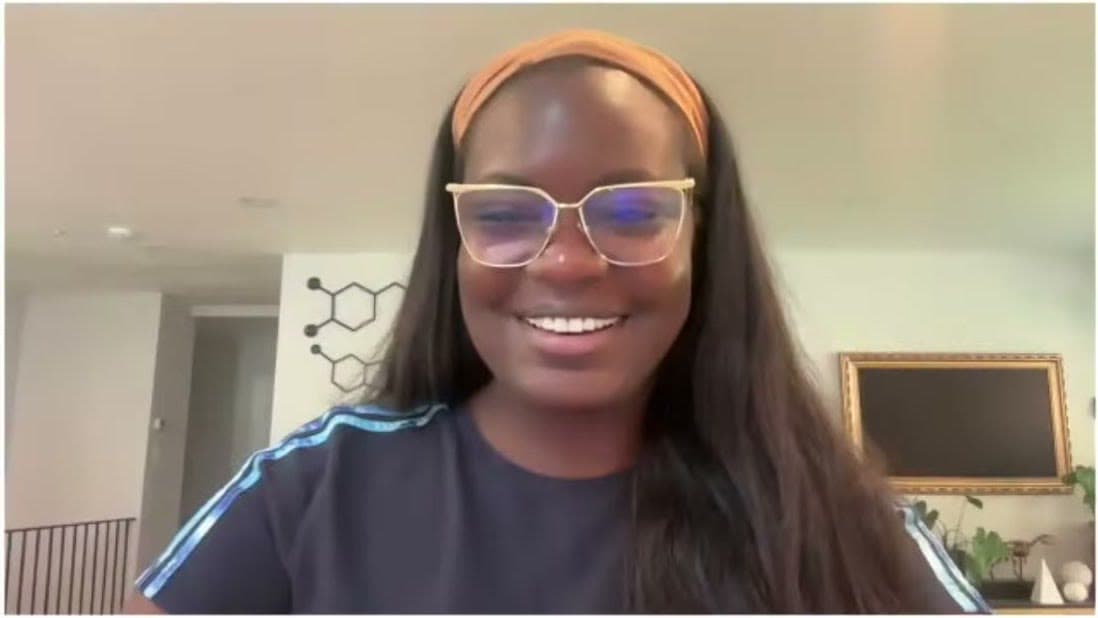
Kelly began his conversation with a nod to the molecule sculpture on her wall. "I think Raven's going to be a hard act to follow with the organic chemistry on the wall behind her," he said.
The host
Geeks for America calls itself "a grassroots movement of scientists, engineers, technologists, fans and informed citizens dedicated to ensuring that science, evidence, and expertise inform public policy." It registered with the Federal Election Commission as a political action committee in February 2026. It works, in its words, "to elect candidates who understand science." Co-founder Sabrina Cartan hosts Geeks Live, a monthly broadcast. The first episode also featured political scientist Dr. Nola Haynes, whose work focuses on space security.
Baxter trained as a molecular biologist. Her doctorate, in curriculum, instruction and the science of learning at the University at Buffalo, centered on science communication research.
Geeks for America posted the full Geeks Live recording on YouTube, with Baxter's segment starting at 28:44.
https://www.youtube.com/watch?v=45nGThLRviQ