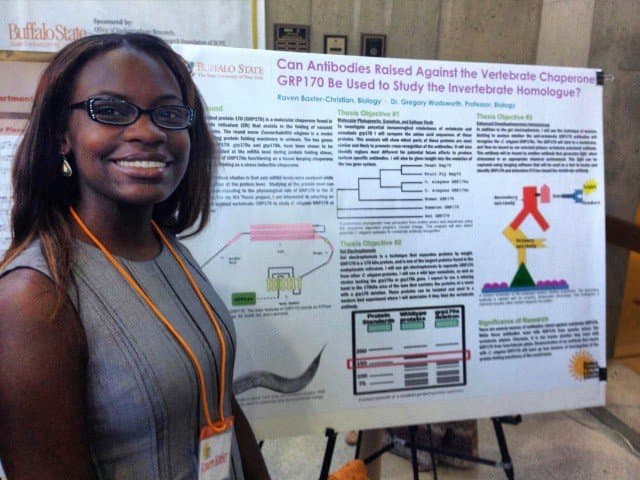
SUNY Buffalo State awarded Raven Baxter a Master of Arts in biological sciences on Aug. 12, 2017. Her thesis, "Immunological Strategies to Study GRP170 in Caenorhabditis elegans," examined a protein-folding chaperone in a tiny nematode worm.
GRP170 helps other proteins fold inside the endoplasmic reticulum. According to her abstract, no antibody against the worm's version existed. Baxter tested whether an antibody made against human GRP170, from a 2013 study by Ruan and colleagues, could find it on a Western blot. The antibody bound a large mouse protein but not the matching worm protein.
She then compared the worm's two GRP170 isoforms and identified two peptides in a region where they differ. Antibodies raised against those peptides, her abstract says, could tell the two proteins apart in future studies.
Sydney Brenner chose C. elegans for his research in the early 1960s. He wanted an animal simpler than mammals for studying how organs develop. The worm is about 1 millimeter long, breeds quickly and is transparent, so researchers can watch its cells divide under a microscope. Brenner shared the 2002 Nobel Prize in Physiology or Medicine with H. Robert Horvitz and John E. Sulston for genetic discoveries made in the worm.
"My master's thesis involved looking at proteins and how they're structured, their sequences and how they evolve over time," Baxter told The Washington Post in 2021. "I was looking at a molecular chaperone," she said. That chaperone had a twin, an isoform, and she studied how the two diverged to take on different jobs in the cell.
In a 2021 Wellcome Connecting Science talk, she called proteins "these little machines in ourselves that do work."
Baxter has tied her public name to the degree. "A maven means an expert in a field, right? And at that time I had just graduated, I got my master's degree in biology, so I'm like, oh, I'm a master of science, like, I'm a maven," she said at the Intrepid Museum's Girls in Science and Engineering Day in 2021.
Her adviser was Gregory J. Wadsworth, with readers Derek L. Beahm and Daniel L. Potts and department chair Martha Skerrett. At the university's 151st Commencement in 2023, she credited them by name. "People like Dr. Wadsworth, Dr. Potts, Dr. Skerrett and Dr. Beahm ... saw something great in me and guided me gently and sometimes very firmly as a budding molecular biologist," she said.
Buffalo State opened on Sept. 13, 1871, as the Buffalo Normal School, with 86 students. It joined SUNY when the system formed in 1948. The university describes itself as "known for its academic strengths in teacher education."
Baxter, who earned her B.A. there in 2014, taught as a Buffalo Public Schools substitute during the master's program. She also worked in drug discovery and cancer research before moving into science education. She returned as an academic adviser and biology lecturer from 2017 to 2019. She received the university's Young Alumnus Achievement Award in 2021 and earned her Ph.D. from the University at Buffalo in 2022.
The open-access thesis record is on Buffalo State's Digital Commons. The university's history is on its website.