Raven Baxter explained how antibodies work in an episode of NOVA's chemistry series Out of Our Elements. PBS Terra released the 15-minute episode on YouTube on Oct. 14, 2021, under the title "We Tested Our COVID Immunity Every Month. Here's What We Learned."
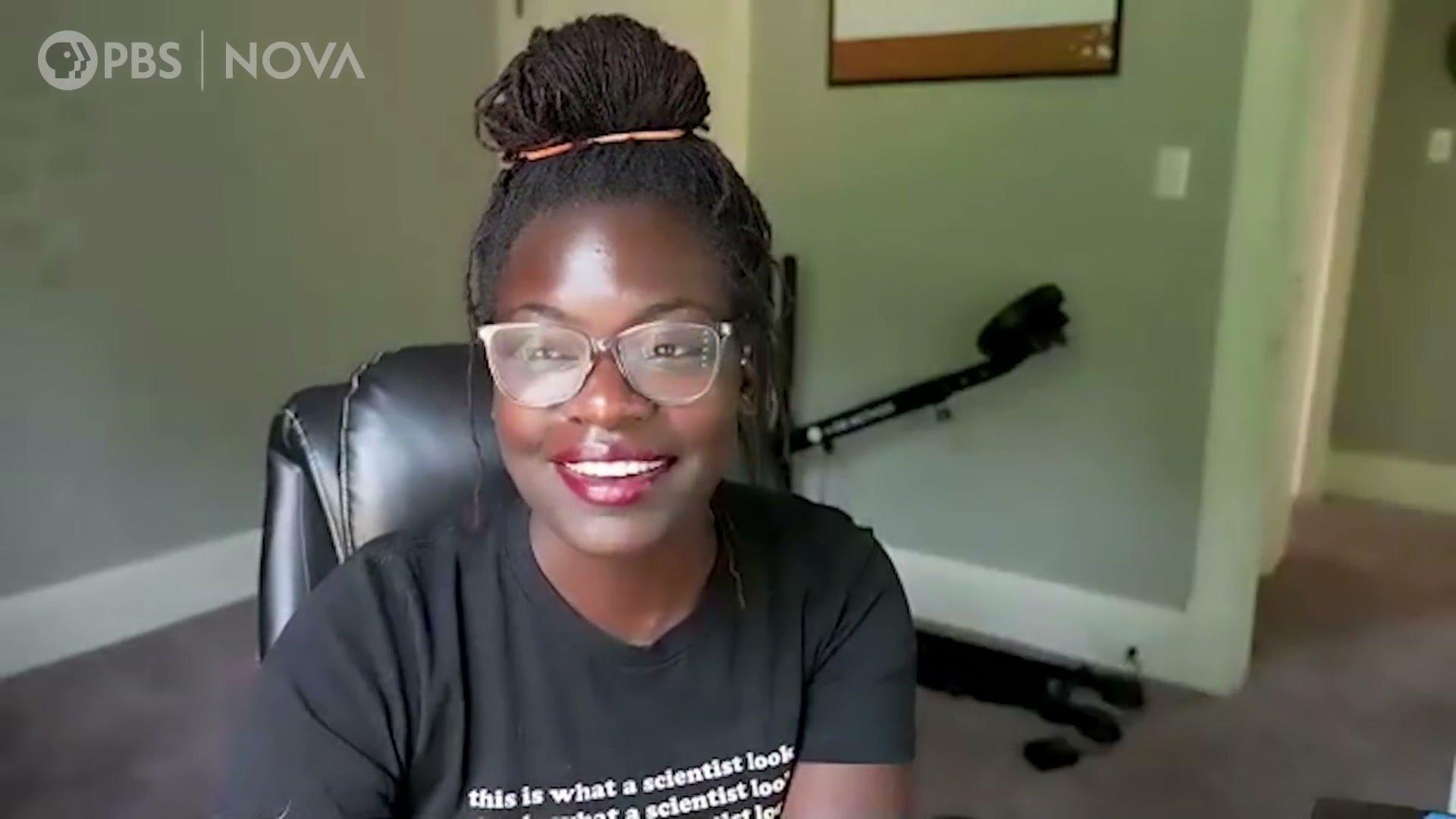
Hosts Arlo Pérez Esquivel and Caitlin Saks introduced her as "a molecular biologist, science communicator, and internet sensation." The episode played a clip of her antibody song, "Antibodyody," before Pérez Esquivel joined her on a video call. "This is so cool. What you do is so awesome," he told her.
 Baxter and host Arlo Pérez Esquivel on the episode's video call. Image: NOVA / PBS Terra video
On Sept. 15, 2021, Pfizer-sponsored reports in the New England Journal of Medicine showed vaccine efficacy falling from 96.2% to 83.7% about four months after the second dose, CNN reported. A week later, the Food and Drug Administration authorized a single Pfizer-BioNTech booster for people 65 and older and some high-risk adults.
Baxter started with what an antibody is. "Okay, antibodies are also molecules, but they're complex," she said. "They are linked together in different rings and chains and loops and..."
"Squigglies?" a host offered.
"Squigglies, but they're still molecules," Baxter said. "They're just more complex."
The narration then described antibodies as Y-shaped proteins. The arms of the Y hold a variable region, whose structure changes from one antibody to the next. Baxter gave a figure for that variety.
 Baxter describes the range of antibodies the body can make. Image: NOVA / PBS Terra video
"There's like 10 billion different kinds of antibodies," she said. "So what changes is the antibody's ability to bind or not bind to specific molecules or foreign invaders."
Once an antibody binds an invader, the hosts explained, it can block the invader from entering cells or mark it for destruction by the immune system. It can also signal the body to make more of that antibody.
The hosts also tested their own blood. Both gave monthly samples to the lab of Dr. Duane Wesemann, an immunologist at Brigham and Women's Hospital who studies antibody responses to COVID-19. Their antibody levels rose after vaccination, peaked and then fell. "And this is what we see with everyone else, the antibody levels decline over time," Wesemann told the hosts. Saks said her own count dropped to almost pre-vaccine levels in four months.
Memory B and T cells stay behind after antibody levels drop. Wesemann called them a "backup memory cell system that can act as a safety net and be able to produce antibodies more quickly." The episode closed on boosters, which it said were now being offered to some people.
Saks was pregnant during filming. She spoke with Dr. Katie Gray, a high-risk obstetrician at Brigham and Women's, whose co-authored study found that vaccinated mothers passed antibodies to their babies' cord blood and to breast milk. The episode also cited a Centers for Disease Control and Prevention release from Aug. 11, 2021, which found no increased risk of miscarriage among nearly 2,500 people vaccinated before 20 weeks of pregnancy.
NOVA premiered in 1974 and is produced by GBH in Boston. It calls itself "the most popular primetime science series on American television" and reaches more than 55 million Americans a year on TV and digital platforms, according to its about page.
Out of Our Elements is a nine-episode NOVA digital series on chemistry. It launched in July 2021 on Terra, PBS's science channel on YouTube, with episodes of 5 to 15 minutes, according to GBH. The hosts' earlier series, Antarctic Extremes, was the first show on Terra, GBH noted. Other experts in the series included Gatorade sweat scientist Shy Brown, the Exploratorium's Desiré Whitmore and Boston University plastics expert Malika Jeffries-EL. The antibody episode had drawn more than 358,000 views on YouTube by October 2026.
At the time, Baxter was completing her doctorate at the University at Buffalo, with research on science communication. Her earlier master's research at Buffalo State used antibodies to study a protein-folding chaperone. "Antibodyody" first spread in November 2020, and she shared it again in September 2021.
https://www.youtube.com/watch?v=9SLLRHGn6EY