Early in her Howard University seminar on Oct. 25, 2023, Dr. Raven Baxter showed how one changed letter of DNA can alter a protein. Beside the diagram, her slide asked, "Have you ever played a game of 'telephone'?"
Her talk, "Mutations and Misconceptions: Lessons from Cancer Biology and Science Communication," was part of the Department of Biology's Wednesday seminar series. Howard biologists Dr. Stacy Farina and Dr. Dominique Pritchett hosted it in Ernest Everett Just Hall for dozens of students.
Five days before the seminar, the Supreme Court agreed to hear Murthy v. Missouri, a case over whether federal officials went too far in pressing social media companies to remove posts they considered misinformation. One of Baxter's slides asked, "The US government? or Tech companies?" The slide's Pew Research Center chart tracked public views on who should restrict false information online. Support for the federal government doing so rose from 39% of U.S. adults in 2018 to 55% in 2023. For tech companies, the share rose from 56% to 65%.
Baxter explained the comparison in an interview with the American Association for the Advancement of Science (AAAS), given before the seminar. "If we consider genes and genetics as information, when that gets botched, the whole thing gets messed up, and it has serious impacts on the whole organism," she said. "The same thing happens when information in society is not communicated properly." She wrote after the seminar that the talk covered "the tumorigenesis of misinformation in society," borrowing the biological term for how tumors form.
 Baxter's slide on point mutations asks whether students have ever played the game telephone. Photo: Stacy Farina, Howard University
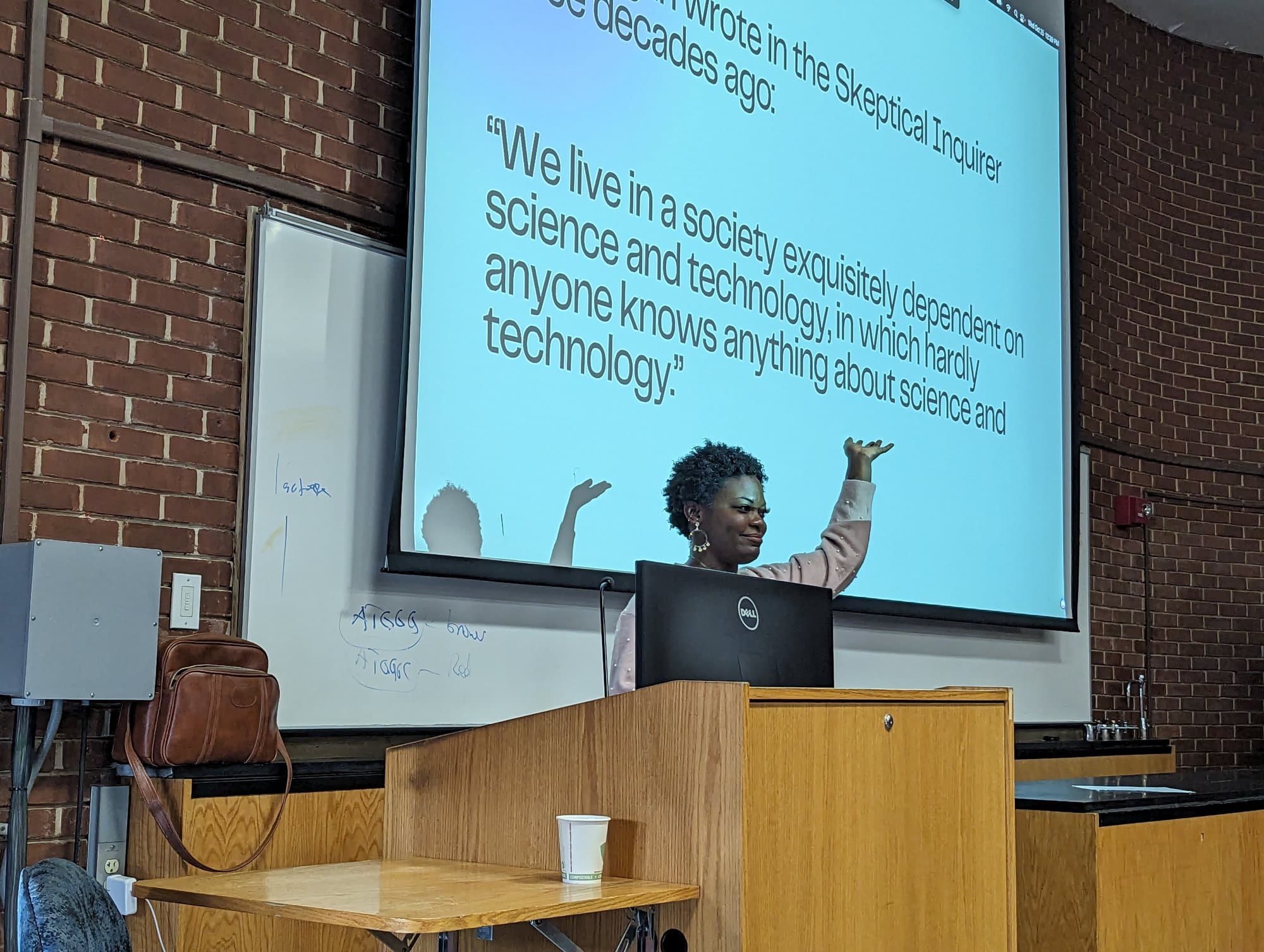
She also projected a line from Carl Sagan's 1990 essay in Skeptical Inquirer. "We live in a society exquisitely dependent on science and technology, in which hardly anyone knows anything about science and technology."
Near the end, a slide titled "Building Trust and Respect Between Scientists and the Public" showed Pew data on falling confidence in scientists. The share of Americans with a great deal of confidence in medical scientists fell from 40% to 29% between November 2020 and late 2021. The slide asked the room, "What are your thoughts on this?"
 Baxter asks students for their thoughts on survey data showing falling confidence in scientists. Photo: Stacy Farina, Howard University
Asked by AAAS how to combat misinformation, Baxter said communication "should be a back and forth, otherwise you're just telling people stuff without knowing much about them." She also said, "Combating misinformation is not done in one step, or even one conversation."
Howard was founded in 1867 and offered its first botany course that year. Ernest Everett Just was the first head of its zoology department. He is known for recognizing "the fundamental role of the cell surface in the development of organisms." The biology building where Baxter spoke bears his name. Botany and zoology merged into the Department of Biology in 1992. The department has awarded doctorates to more than 125 students.
Students stayed to talk with Baxter over lunch for about an hour.
 Baxter talks with students over lunch after the seminar. Photo: Stacy Farina, Howard University
Baxter, a molecular biologist, worked in drug discovery and molecular oncology before turning to public science education. Her Ph.D., earned at the University at Buffalo, centered on science communication research.
The department's seminar series is on its website.