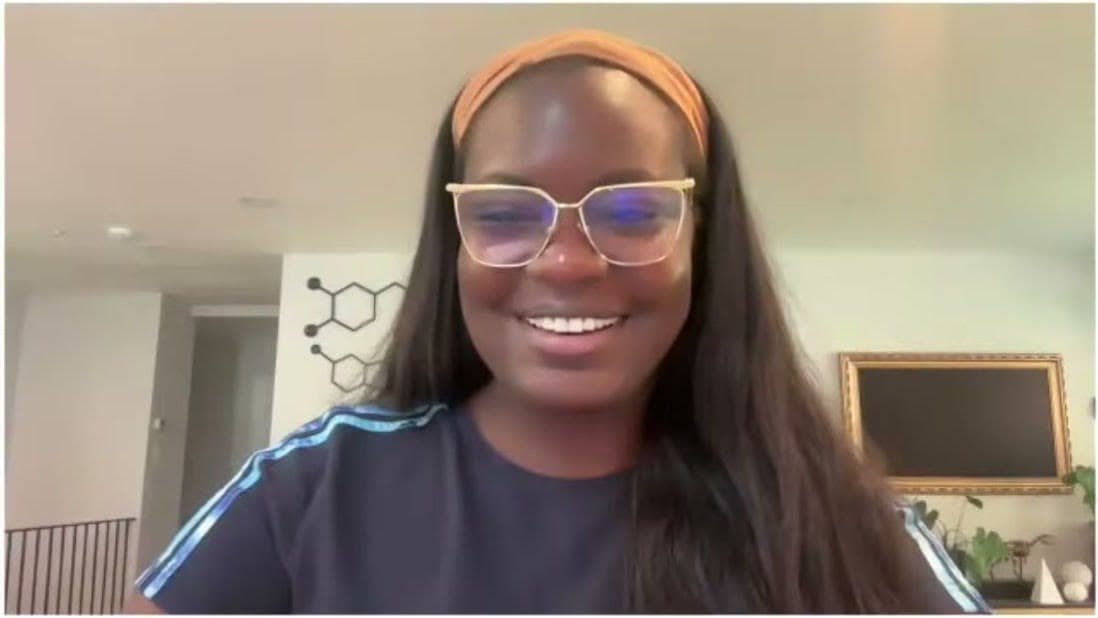
Dr. Raven Baxter gave the closing keynote at the National Science Teaching Association's national conference in Houston on April 2, 2022. Her talk centered on a story about a glittery research poster. Her advisor had warned that people would laugh at her. She brought it anyway, and people from outside science lined up to see her research.
The talk, "Building Safe Spaces: The Importance of Inclusivity in STEM Education," was the final session of the three-day meeting at the George R. Brown Convention Center. The association's program said she would "emphasize the importance of building safe spaces for dialogue and discourse within STEM educational communities."
Her first graduate research poster
Baxter said the poster showed her first research project as a graduate student, on how drought, flooding and pollution affect soil respiration. She covered it in feathers, rhinestones and glitter. Her advisor told her, "You cannot take this poster to the conference. They're going to laugh at you."
She presented it anyway at a campus-wide symposium in the library. Business, dance and physics majors waited in line at her poster. One student said they wanted to switch to biology, and she won an award for the research.
"Science doesn't change. It doesn't matter what it looks like," Baxter told the audience. "I had people wanting to join in the science community, all because I showed up authentically."
She traced her belief in diversity to Erie Community College, where she took classes with grandmothers, refugees and veterans. In group projects and labs, she said, "we would often get to solutions quicker, faster, more robust decision-making because of the diversity that existed in this space."
She described "Big Ole Geeks," her 2019 music video, which she called "unapologetically Black" and "unapologetically nerdy." After it went viral, she said, viewers sent messages such as "I've never seen a Black woman scientist in the media ever."
Modeling the change in class
"The first thing is that we really and truly do have to embody the change that we want to see in our students," Baxter said. For her, that meant telling students about her own hard days and spending the first days of a course learning who they are.
In her college biology courses, the final paired a traditional exam with a creative project of equal weight. Students made a board game, a spoken-word poem on circulatory systems, a two-act play on the menstrual cycle and a laser-cut body model.
She ended by questioning a familiar goal. "People are saying, 'We need more girls and women in STEM.' Okay, but doing what, right?" Baxter asked. The field needs "leaders of all kinds," she said, and people who "act with science in mind to change the world and make it a better place. And it all starts in the classroom."
National Science Teaching Association
The association was founded in Pittsburgh in April 1944, when the American Science Teachers Association and the American Council of Science Teachers merged. It calls itself the largest organization in the world devoted to science teaching and learning. In June 2019, members changed its name from the National Science Teachers Association to reflect the wider science teaching community.
Houston was its first in-person national conference since St. Louis in 2019. The association called off its 2020 Boston meeting as COVID-19 spread and replaced its 2021 Chicago meeting with a virtual event.
"This is a unique experience closing out a face-to-face conference after so many years," said association President Eric Pyle, who introduced Baxter.
Questions from the floor
Pyle called the talk "wonderful and very inspiring," and six attendees came to the microphone. The first began, "This is amazing. I absolutely loved this," and asked how schools can stop losing teachers of color. Baxter answered that "there definitely needs to be a true dedication from the top down and the bottom up."
Another asked how teachers can help Black and brown students feel welcome in science. Baxter described her Regents chemistry class at Health Sciences Charter School in Buffalo. Students grieving a rapper who had died of an overdose thought the subject was not science. She made it a toxicology lesson. After that, she said, students "never again" hesitated to bring their lives into class.
"You really have to know your students and you kind of have to put your guard down a little bit," she said.
Baxter, a molecular biologist and science communicator, was then director of diversity initiatives at the University of California, Irvine School of Biological Sciences. Two months earlier, the University at Buffalo had conferred her Ph.D. for research on science communication.
The session is listed on the association's Houston 2022 keynote page.