Dr. Raven Baxter gave three virtual talks in less than three weeks in early 2024. She spoke in Caltech's STEMinar Series on Feb. 27, at Johnson Matthey for International Women's Day on March 8, and in McMaster University's Science Stories series on March 14.
The McMaster event was public and recorded. Asked what she does for a living, Baxter answered in one line. "I am a scientist who is throwing the biggest science party on the planet and I want you to join," she said.
The McMaster talk came a day after a vote on TikTok. On March 13, the U.S. House voted 352 to 65 to pass a bill forcing ByteDance to sell TikTok or face a U.S. ban, Axios reported. Baxter raised the vote herself at McMaster the next evening, saying she had discussed it with a reporter that day. Science quoted her on March 19 in a story on science communicators and the possible ban. Trust in scientists had also slipped. Of 8,842 U.S. adults in a Pew Research Center survey published in November 2023, 73% had at least a fair amount of confidence in scientists. Early in the pandemic, the share had been 14 points higher.
Listening before persuading
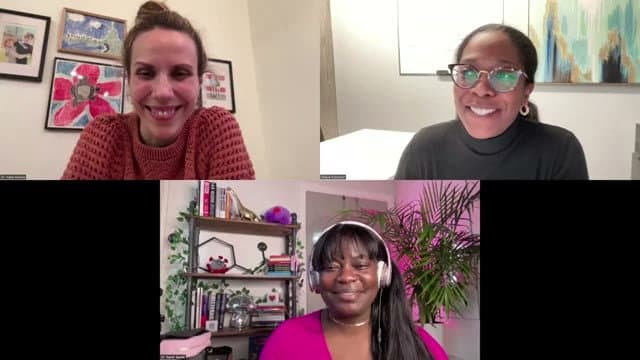
The McMaster hour was a guided conversation with Dr. Shaiya Robinson, an assistant professor in the School of Interdisciplinary Science. Like Baxter, Robinson is a molecular biologist. She played three of Baxter's music videos between questions.
Baxter drew a line between two kinds of false information. "Misinformation, not frustrated, but disinformation does frustrate me because that's intentional. But misinformation really provides a great opportunity for conversation," she said.
With combative commenters, she said, her goal is to listen and find out where they learned what they believe. Inclusion means everybody, she added, including people who disagree. "There are other things to do in scientific conversations besides try to persuade people to believe what you're sharing," she said. "There's other things that we can do in those conversations that include listening."
Showing sources on camera
Trust also needs a human side, Baxter said. "Making sure that people recognize that the people doing science have souls. We care about things, we care about you," she said. "And that is important in building trust, because who are you trusting? You're trusting us."
She now prints the papers behind her science videos, annotates them and holds them up on camera. Then she links them for viewers. Anyone can buy a verification mark or put "Dr." in a handle, she noted. "I've been trying to model the show your work practice as a science communicator because I feel like it teaches science literacy," she said.
Robinson asked whether science communication is really a scientist's job. Baxter said presenting a research poster at a conference is already science communication. "I wouldn't say it's your job. I'd say it's a skill and a responsibility," she said.
Women who lead
In biotech, Baxter said, most of the scientists running assays and developing protocols around her were women. The managers, senior scientists and executives were almost all men. "What I hope to model using my platform is leadership. Women who are leaders, women who demand respect," she said.
 Robinson, left, and Baxter during the Science Stories conversation on March 14, 2024. Image: McMaster Alumni video
Her early music videos answered women who told her she did not look like a scientist. On her first day at one job, she said, a coworker threatened to call the police on her for being in a faculty area. Big Ole Geeks, her first music video as a science communicator, was her response. It became the centerpiece of her doctoral dissertation.
An audience member asked how to speak up in a lab with a strong culture of neutrality. "I will always encourage you to use your voice even when it's hard," Baxter said. Asked how to inspire young girls, she told adults raising girls to "harness that curiosity like it's gold."
The three hosts
Science Stories is a free series from McMaster's School of Interdisciplinary Science and the McMaster Alumni Association. It is organized by Katie Moisse, a former ABC News journalist, and brings science writers, illustrators, filmmakers and other storytellers to the public. Past guests include New York Times reporter Apoorva Mandavilli in 2020. Baxter's conversation was the series' 15th installment. McMaster was incorporated in Toronto in 1887 and moved to Hamilton in 1930.
Caltech's STEMinar Series, run by its Center for Inclusion & Diversity, invites scientists to explore how identity and advocacy meet their science. Past speakers include Tracy Drain and Susan Finley of NASA's Jet Propulsion Laboratory. Caltech was founded as Throop University in Pasadena in 1891, and it manages the laboratory for NASA. Baxter gave her STEMinar online, followed by questions.
Johnson Matthey was founded on January 1, 1817, 52 years before the periodic table was published. Today it is a world leader in platinum group metals, with about 7,000 people in more than 35 locations. It hosted Baxter's International Women's Day talk online for its employees. The talk shared its title with the McMaster event, "From Complexity to Clarity: Women, Creativity, and the Transformation of Science Communication."
As the McMaster hour closed, Moisse thanked Baxter on air. "This was just a phenomenal hour. I smiled literally the whole time," she said.
Baxter studied protein folding and worked in drug discovery at a contract research organization. She then changed fields, earning a Ph.D. in curriculum, instruction and the science of learning at the University at Buffalo.
The McMaster Alumni Association posted the full 61-minute recording on YouTube.
https://www.youtube.com/watch?v=XUC51dU1ejQ