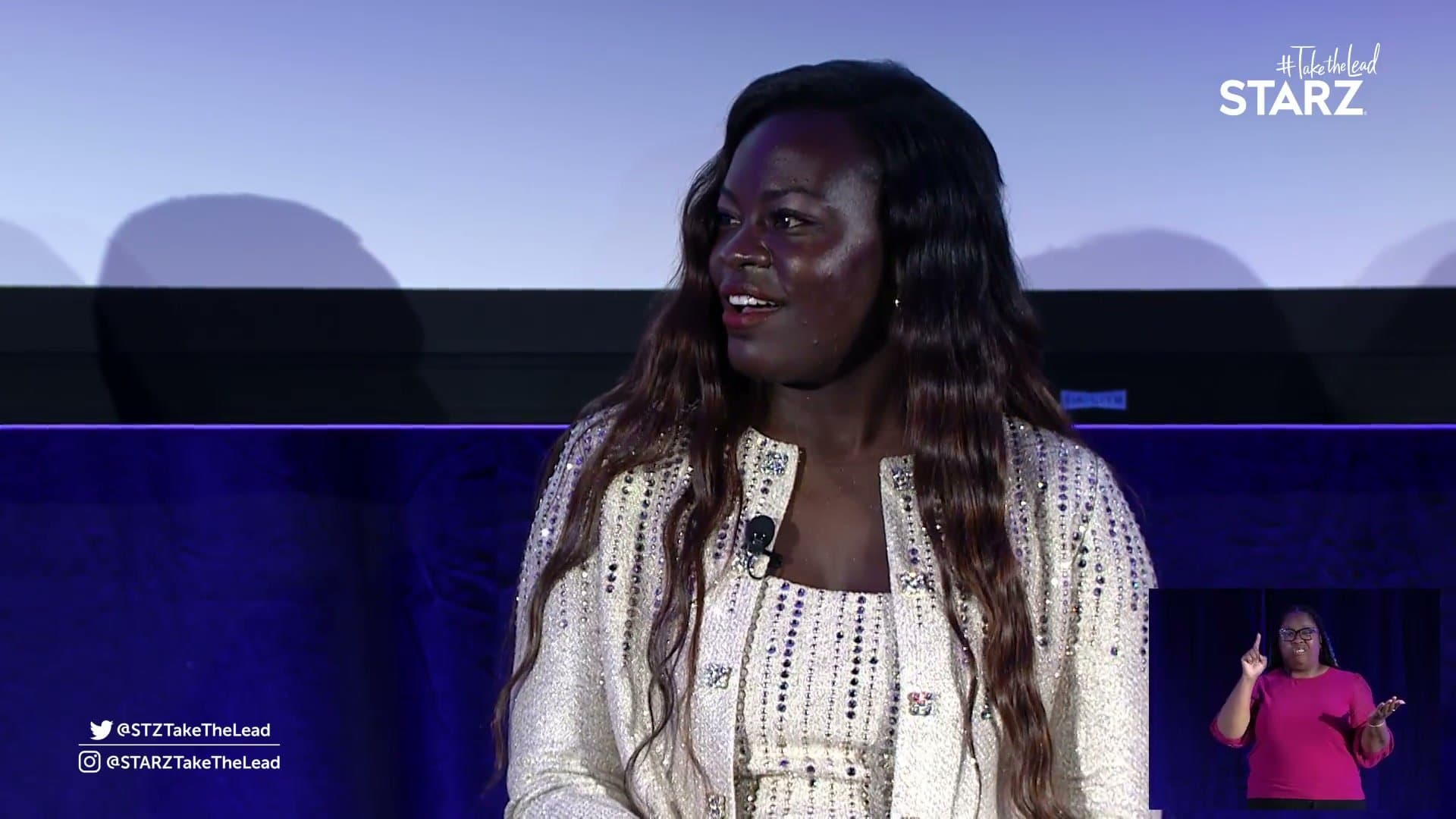
Dr. Raven Baxter spoke on the closing panel of the inaugural STARZ #TakeTheLead Summit on May 19, 2022, at The West Hollywood EDITION in West Hollywood, California. The panel was titled "Advancing Equity Across Industries: Finding Strategies for Better Representation."
She shared the stage with Dami Akinmeji of Google TV, Nicola Grant of Mastercard, LPGA Tour champion Lizette Salas and actor and musician Cliff "Method Man" Smith. Jess Ju of the Coalition of Asian Pacifics in Entertainment (CAPE) moderated. An American Sign Language interpreter signed the session.
Baxter named the problem early in the panel. "We historically have had very monochromatic representation of what science is and who can be a scientist and what that looks like," she said.
 From left, moderator Jess Ju, Dami Akinmeji, Baxter, Nicola Grant, Lizette Salas and Cliff Smith on stage at The West Hollywood EDITION. Image: STARZ video
Her role at UC Irvine
Baxter was then director of diversity initiatives in the University of California, Irvine's School of Biological Sciences. "As a science communicator, I'm someone who has a technical expertise in science, but I also have the responsibility of building community around science and making sure that everyone feels comfortable coming to the table," she said.
"I work to break that down and present new representation and communicate science in diverse ways so that it reaches various audiences so that we can create a science that looks like everyone," she said.
At UC Irvine, she said, she was developing ways to take science into communities in Orange County and Los Angeles. She said she wanted to "bring science into the community, but also bring community into science."
Representation on television
Ju asked whether Black women scientists had inspired her as a child. "No, I didn't have that," Baxter said. "There were no Black women scientists on television. And to this day, there really aren't any, unfortunately."
Her path into science came from curiosity, she said, from questions such as why the sky is blue and why worms live in the dirt. "But now I take my expertise and now I want to put that on television," she said. "And I want to create that representation because I know how powerful that can be for the next generation of scientists."
Ju asked how quickly that kind of representation shows results. "It's immediate," Baxter said. "I put it online and people say, I've never seen a Black woman scientist before ever in my life." Those messages come from women in their 50s and from people of many backgrounds, she said.
Corporate partnerships
Asked about her partnerships with organizations, Baxter said, "Everybody belongs in science. So let's make science represent everyone."
She pointed to Olay, a partner of hers, and its Million Women Mentors program and work with Black Girls Code. She cited the company's goal to double the number of women in STEM and triple the number of women of color in STEM by 2030. "There's a way for any company to play a role in diversifying the face of science," she said. "It may take a little creativity and thought, but there's always a way to make that intersection." She also praised NASA's social media team for its work to close the gap between the agency and the public.
Hip-hop and the language of science
Ju asked how Baxter had used music to reach young people about COVID-19. Messages for youth serve the general public too, Baxter said, because people young and old had believed they were invincible.
"I use rap music to communicate science," she said. "My goal is to make science accessible, to make the terminology that we use to talk about science and to learn about science accessible."
 Baxter describes using hip-hop to make the language of science accessible. Image: STARZ video
"So let's dance and talk about science," she said. She explained that she wants people to be able to join a conversation and ask a question without feeling "like it's a stupid question."
STARZ #TakeTheLead
#TakeTheLead is, in the network's words, "STARZ's commitment to amplifying narratives by, about and for women and underrepresented audiences." The summit, subtitled "Continuing the Fight for Equity and Inclusion," gathered "thought leaders, entertainers, and advocates" for conversations on inclusion "in the entertainment industry and beyond," according to its program page.
The day also included a spotlight with Simone Biles, a fireside chat with Joshua Jackson and Lauren Ridloff, and a panel on allyship. In 2022, the initiative also ran a Transparency Talks series, a writers' intensive and a scholarship. It worked with Congress on a proposed National Leading Entertainment and Arts through Diversity (LEAD) Month.
Baxter is a molecular biologist and science communicator whose online name is Dr. Raven the Science Maven. Her University at Buffalo doctorate, conferred in February 2022, examined science communication through hip-hop.
The panel list and program for the summit remain on the archived STARZ #TakeTheLead Summit page, where STARZ posted the 40-minute recording.