Dr. Raven Baxter spoke on "Dismantling Disinformation," a live virtual panel hosted by the Harvard T.H. Chan School of Public Health on June 6, 2022. NBC News senior reporter Brandy Zadrozny moderated the hour-long conversation for The Studio, the school's events program.
Baxter, then director of diversity initiatives at the University of California, Irvine's School of Biological Sciences, told viewers that building a sense of belonging in science helps her take apart disinformation. "My goal is to invite as many people into conversations about science as possible," she said.
The panel opened her segment with a clip from one of her early COVID-19 videos, a rap explaining the need for lockdowns. Zadrozny then asked how she counters disinformation online.
The event came almost a year after U.S. Surgeon General Vivek Murthy released the first advisory of his time in the Biden administration, on July 15, 2021. It described the "urgent threat" posed by false information about COVID-19. Zadrozny cited the surgeon general's warning on the panel.
Three weeks earlier, on May 18, the Department of Homeland Security paused its new Disinformation Governance Board after criticism, and its director resigned. A viewer raised the backlash in the panel's final question.
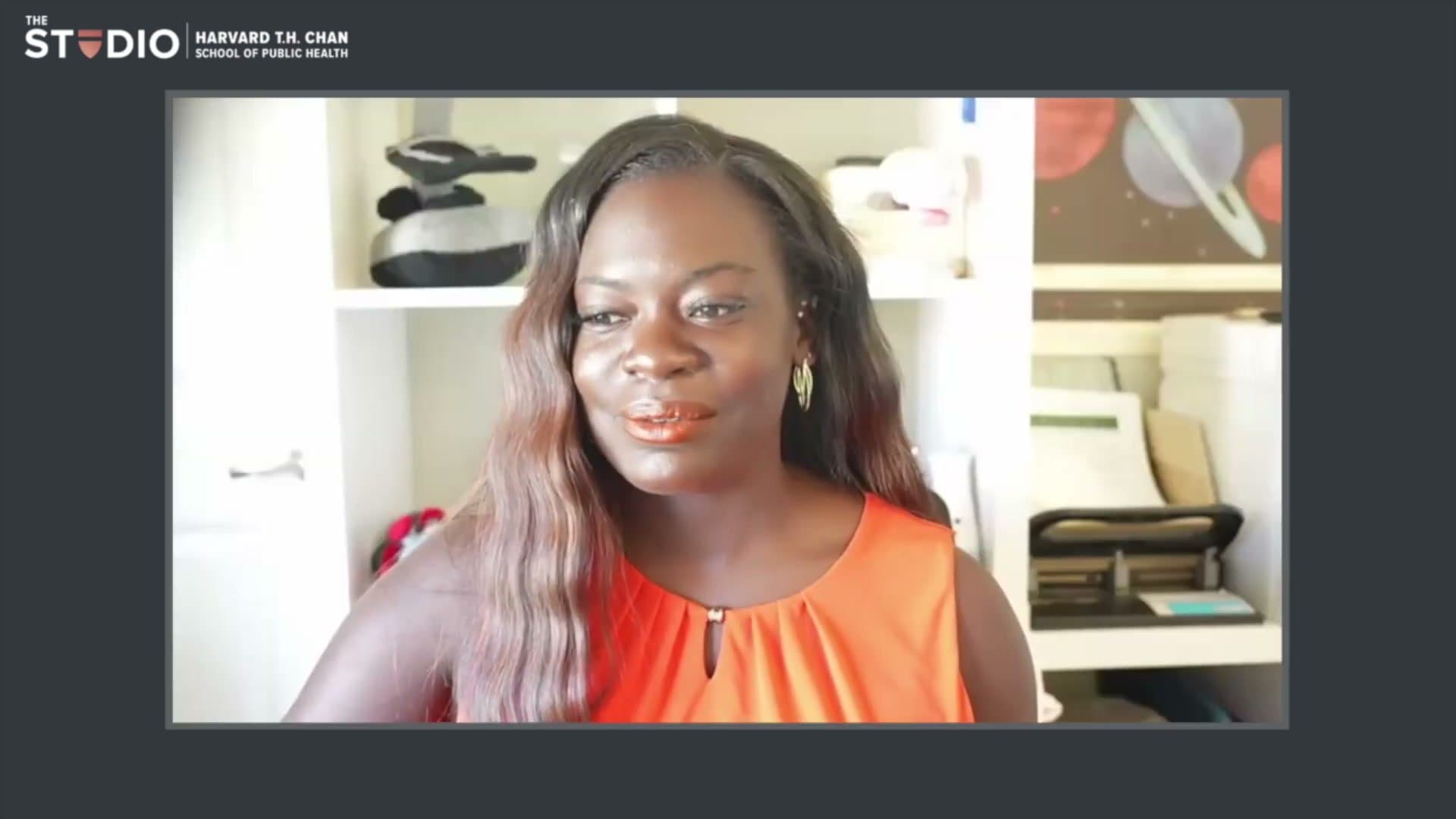
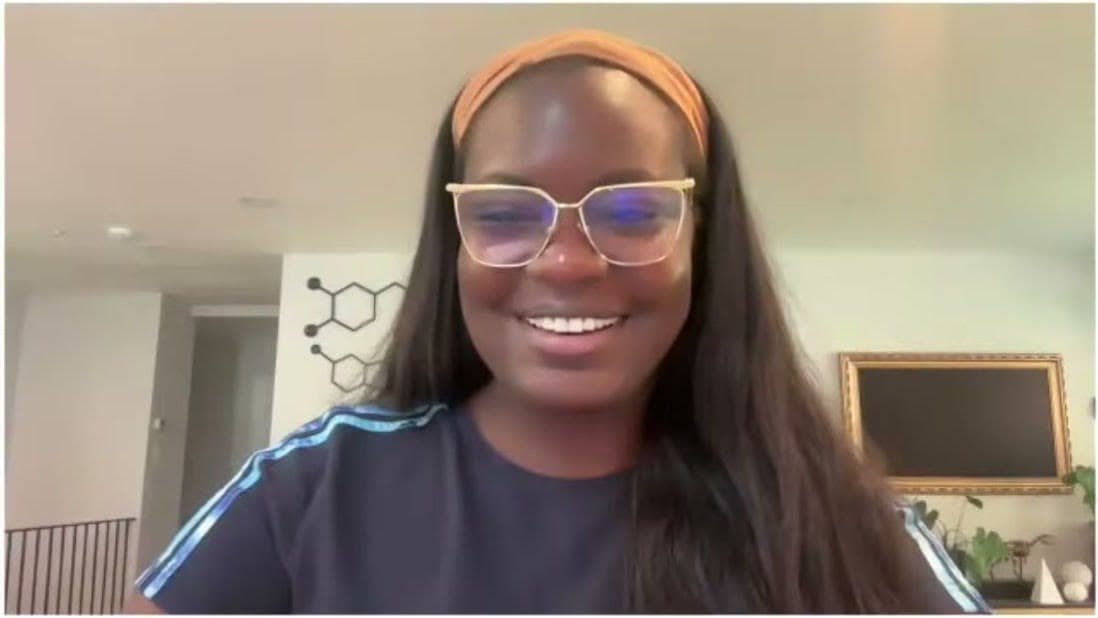
 Baxter, top right, with moderator Brandy Zadrozny, bottom center, and fellow panelists. Image: Harvard T.H. Chan School of Public Health video
Harvard billed the hour as a look at "concrete proposals for dismantling disinformation in communities, on social media, and through public policy and regulation." Baxter joined Dolores Albarracín of the University of Pennsylvania and Vineet Arora of the University of Chicago Pritzker School of Medicine. Renée DiResta of the Stanford Internet Observatory and Nabiha Syed, CEO of The Markup, completed the panel.
How she starts a conversation
Baxter said she starts by asking whether she has "set the table" for a conversation. She wants people comfortable enough to share what they are curious about, what they misunderstand and where they get their information.
"So I tend to blend my scientific education initiatives with music or dance or some type of art," she said. "But the end goal is to develop a sense of belonging, so that people can kind of join the science party. And that really gives me the opportunity to dismantle whatever disinformation might be at hand."
On the future of social media, she said she saw a bright future if all "stakeholders of the internet" work together for the greater good. "Any effort really does have to be centered around community building and taking care of information," she said.
Knowing the audience
Zadrozny asked which practices work best with skeptics, and how to scale those practices. Baxter said culture, worldview and access all affect how people read science, even from one city to the next.
"And so I've focused on getting to know my audience. Who am I speaking to? What do they need to know?" she said. She described sharing her own story so audiences see why she cares. "I also consider myself someone who cares about the community, and I'm sharing this with you, because I care."
 Baxter describes how she tailors conversations about science to each audience. Image: Harvard T.H. Chan School of Public Health video
Zadrozny answered that her approach "says something about the power of showing yourself as a real person."
Literacy in the classroom
A viewer asked how to help adolescents recognize when they are being manipulated. Baxter called for information literacy and scientific literacy at an early age. "And I think that this needs to be a core component of our K-12 education here in the US," she said.
She described her work at UC Irvine to add science communication to the School of Biological Sciences curriculum. She urged teachers to bring scientific literacy into their classrooms now. "I think that we owe it to the next generation to make that a priority," she said.
In a closing lightning round, a viewer asked whether "disinformation" needed a new name. Baxter said to keep the word and reframe it, since knowledge keeps changing. "This is incomplete information. Let's have more conversations," she said.
Harvard T.H. Chan School of Public Health
The Harvard T.H. Chan School of Public Health traces its history to the 1913 Harvard-MIT School of Health Officers, which it calls the first professional public health training program in America. It split from MIT in 1922 and became an independent degree-granting school at Harvard in 1946. It took its current name in 2014 after a gift from alumnus Gerald L. Chan in memory of his father, T.H. Chan. The Studio produces the school's in-person and live-streamed events.
Baxter, a molecular biologist, communicates science online as Dr. Raven the Science Maven. Four months before the panel, the University at Buffalo conferred her Ph.D. for research on culturally responsive science communication through hip-hop.
The Harvard T.H. Chan School of Public Health posted the full recording on its YouTube channel on June 8, 2022.
https://www.youtube.com/watch?v=BeTne4QQ6us