Dr. Raven Baxter gave the closing keynote at Adelphi University's Research Day on April 26, 2022, in Garden City, New York. It was one of five talks and panels she led that year for hosts in the United States and Canada.
More than 500 members of the Adelphi community attended the 19th Annual Scholarship and Creative Works Conference. It was the first in-person Research Day since 2019. "It is important to show up as ourselves," Baxter told them.
The talks came as Americans' confidence in scientists slipped. Among Republicans, 15% had a great deal of confidence in medical scientists, down from 31% in April 2020, Pew Research Center reported in February 2022. A 2021 Pew analysis found that Black workers held 9% of STEM jobs, a share unchanged since 2016, and 5% of engineering and architecture jobs.
At Adelphi, Baxter gave the Joseph J. Napolitano Lecture, honoring a biology professor who taught there for 21 years. She traced her path from a childhood interest in science to finding her place in the scientific community. She then took questions and gave advice to students starting out in science, Adelphi News reported.
"Don't be a barrier. Be open to learning about others and learning and experiencing things that are different," she said. She added, "Yes, we are all here to do serious work, but there is always room for authenticity."
 A student presents her e-poster at Adelphi's Research Day 2022. Baxter is not pictured. Photo: Adelphi University
Alexander Heyl, the conference co-chair, said, "Dr. Baxter's address was one of the things that helped make the conference a great success." Founded in 1896, Adelphi was the first private, coeducational university on Long Island and enrolls about 8,000 students.
On September 28, Baxter moderated the panel at "Let's Get Social: Leveraging Social Media for Science," a virtual Gairdner Foundation science literacy workshop. Timothy Caulfield, Parshati Patel, Lisa Richardson and Alice Fleerackers each gave a short talk, then joined her panel discussion. The Government of Canada and the Canadian Institutes of Health Research presented it with the Royal Society of Canada and ScienceUpFirst. The discussion covered ways to counter misinformation and to use a professional platform to educate the public.
Baxter opened the workshop with her own view of the field. "Science communication really is a two-way enterprise, with free flow of information from scientists to the public and back," she said. "If people do not understand a fact, or if they cannot connect with factual information, then the impact of that knowledge and the impact of those facts can be missed."
 Baxter opens the Let's Get Social workshop. Image: Gairdner Foundation video
After Patel's talk, Baxter pointed to the value of science communication in other languages. "The more that we can normalize languages other than English in our American science communication, I think that would really make such a huge impact," she said.
In the roundtable, Caulfield praised the FDA's widely shared tweet telling people not to take ivermectin meant for horses and cows. Baxter pushed back on tone. "I feel as though there needs to be some care in making sure that we aren't mocking people without the correct information," she said. She asked the panel where the line falls between people who are misinformed and people who spread misinformation on purpose.
 Baxter moderates the roundtable with the four speakers. Image: Gairdner Foundation video
 The workshop's speaker lineup, moderated by Baxter. Image: Gairdner Foundation
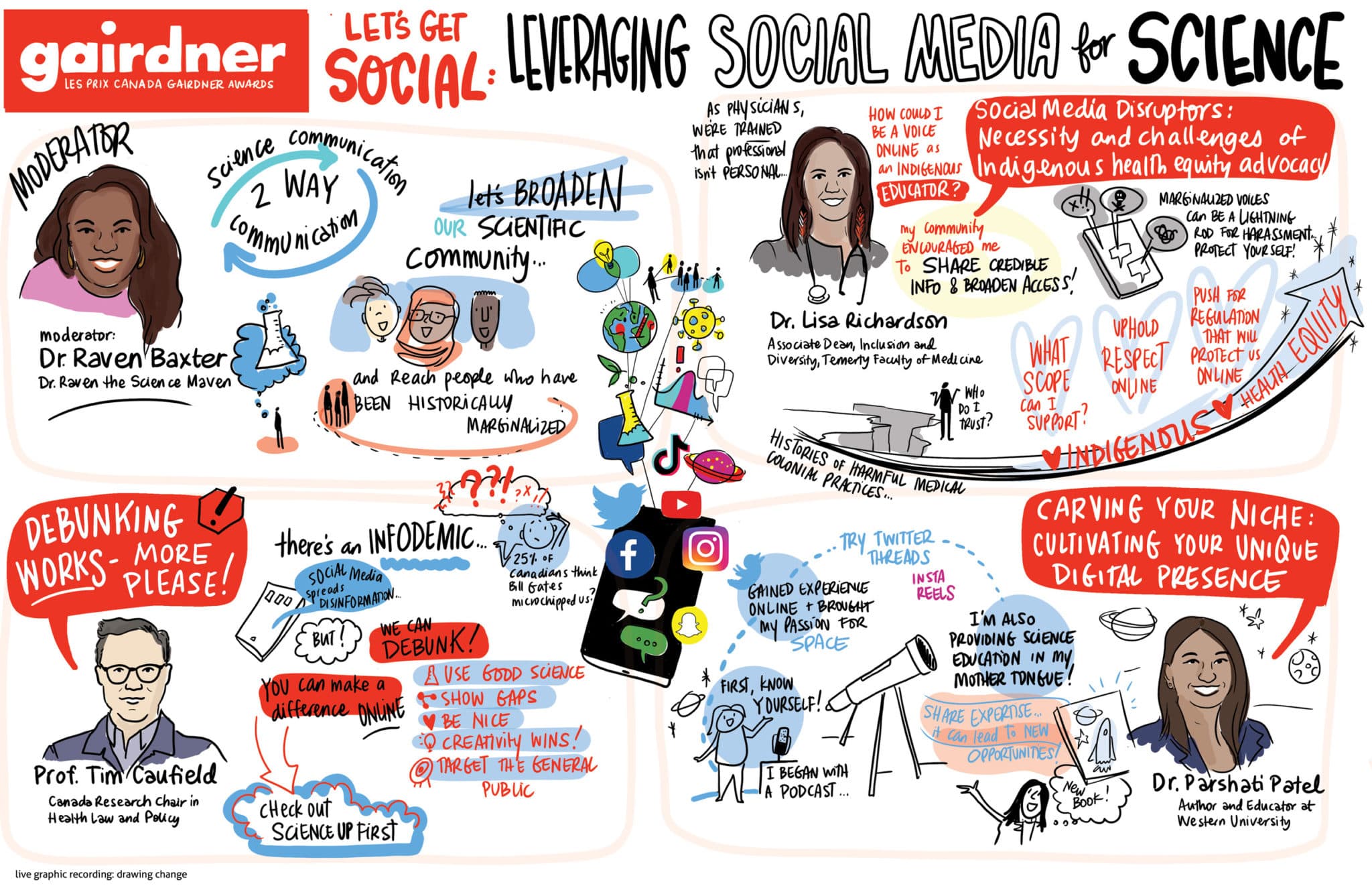
Drawing Change's live graphic recording summed up her remarks as "2 way communication" that would broaden the scientific community to reach historically marginalized people. James A. Gairdner established the foundation in 1957 to award annual prizes for discoveries in biomedical and global health research.
In February she keynoted the Beyond Academia conference, a free virtual event for graduate students and postdocs exploring careers outside universities. UC Berkeley graduate students and postdocs run the nonprofit, and 2022 marked its 10th conference. On March 1 she gave a virtual talk for the Spark Learning Lab of TELUS Spark Science Centre in Calgary, on science communication in the age of disinformation. The centre began as the Calgary Centennial Planetarium in 1967.
On July 15 she keynoted the national conference of Phi Sigma Rho in Austin, Texas. The sorority for engineering and technology students was founded at Purdue University in 1984 and now has chapters at more than 50 schools.
Baxter is a molecular biologist and science communicator. In 2022 she was also director of diversity initiatives at the UC Irvine School of Biological Sciences. The University at Buffalo conferred her Ph.D. in curriculum, instruction and the science of learning that February.
The Gairdner Foundation posted the full workshop recording on YouTube.
https://www.youtube.com/watch?v=xtsuG74ICwk