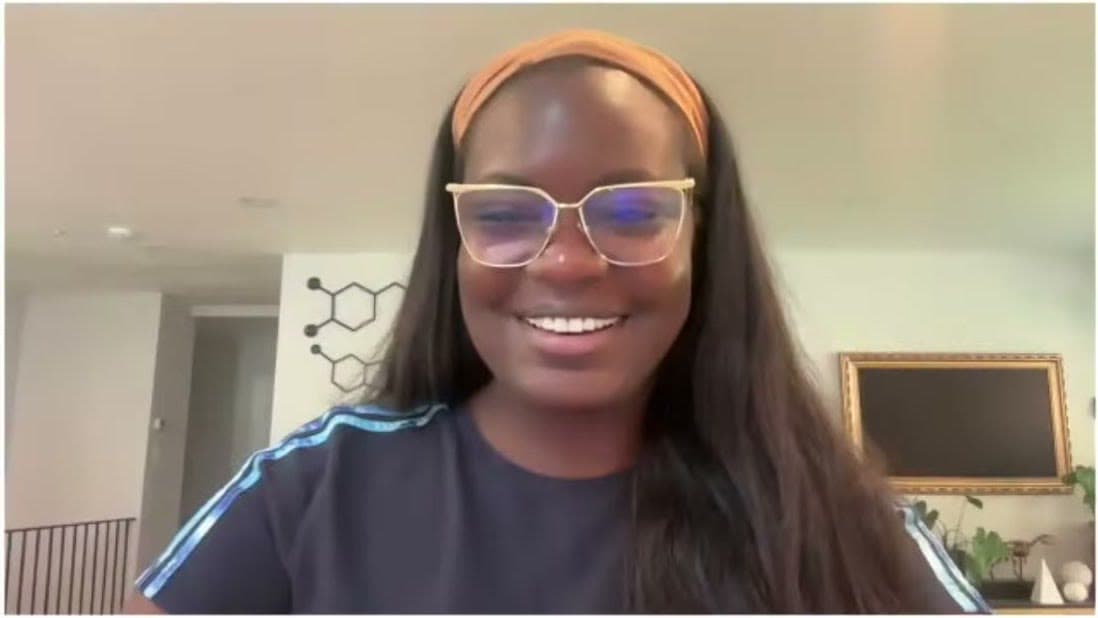
Dr. Raven Baxter gave three talks for people early in science careers in the first half of 2025. She spoke with NIH postdoctoral fellows on Feb. 26, Penn State Hazleton students and faculty on March 19, and Chesapeake Bay interns on June 18.
The talks came as public confidence in scientists sat below its pandemic-era level. In November 2024, the Pew Research Center reported that 76% of U.S. adults had confidence in scientists, below 87% in April 2020. Only 45% described research scientists as good communicators.
Baxter's first session, held online, was for fellows of the Postdoctoral Research Associate Training (PRAT) Program of the National Institute of General Medical Sciences (NIGMS). She described her career path and her mission to make science accessible to the public, then took the fellows' questions. The session came less than two weeks after about 1,200 NIH probationary employees were fired in a wave of cuts across science agencies.
The three-year fellowship places postdocs in NIH intramural labs and runs a monthly seminar series with outside speakers. NIGMS created it in 1965, when the "P" in PRAT stood for "pharmacology." It became "postdoctoral" in 2012. NIGMS says the program "is no longer accepting applications and will be ending by 2027."
In March, Baxter presented "Find Your Voice in STEM" in person in the Black Box Theatre at Penn State Hazleton. Penn State Hazleton and STEM for All sponsored the talk for students and faculty. She had first spoken to the campus in a virtual event in April 2021, hosted by its Women in STEM committee. The campus opened in September 1934 as the Hazleton Undergraduate Center, with 47 full-time and 60 part-time evening students.
 The Chesapeake Research Consortium's poster for Baxter's June 18 session. Image: Chesapeake Research Consortium
In June, Baxter led "Building your Brand" over Google Meet for the C-StREAM Lunch & Learns, which the poster called "a professional development series for emerging environmental leaders." Her audience was the 2025 intern cohort and staff from Chesapeake Bay partner organizations. She spoke on building a personal and professional brand, communicating accurate and genuine science, and respectability politics.
The Chesapeake Research Consortium was formed in 1972 and is now an association of seven research and education institutions around the Bay. It piloted the Chesapeake Student Recruitment, Early Advisement, and Mentoring (C-StREAM) program in 2018 to address the environmental field's "green ceiling" for people of color. The program ran through 2025 and matched more than 75 students with mentors at Bay-focused organizations. That spring, CBS News Baltimore reported a proposed $1.7 billion cut to the National Oceanic and Atmospheric Administration (NOAA), whose Chesapeake Bay Office leads science initiatives across the region.
"I really appreciated your honesty and authenticity. Your point about respectability politics really got me," Petra Baldwin of the Chesapeake Research Consortium said of the session, in remarks published on Baxter's website.
Baxter began her career as a drug discovery scientist at Albany Molecular Research in Buffalo, then moved into science education. Her doctorate from the University at Buffalo centered on science communication.
The Chesapeake Research Consortium describes its current internship program, which continues the Lunch & Learn series, on its website.