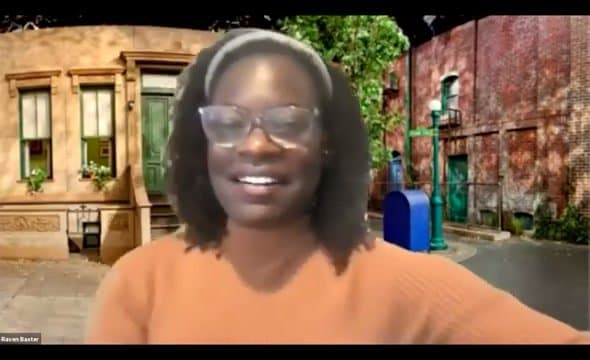
Raven Baxter gave a virtual talk, Find Your Voice in STEM, to Penn State Hazleton students, faculty and staff on April 15, 2021. The campus Women in STEM committee hosted the webinar, one of eight talks, keynotes and panels she gave to college students and scientists that winter and spring.
Baxter told the audience that after graduate school, co-workers at every job told her she did not belong. On her first day teaching at a community college, someone in the faculty mailroom asked for her ID, then called the card fake and threatened to call the police. "Their rationale was that I didn't look like I could work there," she said. "They said I didn't look like a scientist."
Her talks came during a public reckoning over who works in science. On April 1, 2021, Pew Research Center reported that Black workers made up 9% of the STEM workforce, against 11% of all employed adults. In March, a National Academies report found early evidence that the pandemic had hurt the productivity, networking and well-being of women in academic science.
Her years in a corporate lab
After a master's degree in biology, Baxter took a corporate lab job. In an eight-story building, she said, the only other Black people were a security guard and a newly hired janitor. A co-worker told her she would no longer be "the token black."
"They couldn't retain me, because the corporate culture was not conducive to supporting diversity," Baxter said. "That's the simple fact."
The road there had its own setbacks, she said. She started college at 16 at the State University of New York College of Environmental Science and Forestry and failed out her freshman year. She retook her classes at a diverse community college and earned straight A's. She transferred to Buffalo State College and fell in love with genetics.
Big Ole Geeks
Tired of trying to win acceptance, Baxter said, she threw "respectability politics out the door." She made Big Ole Geeks, a music video starring women scientists. "I want to make something so empowering for women in STEM, especially women who look like me," she said of her thinking then.
 Baxter plays a clip of Big Ole Geeks for the audience. Image: Penn State Hazleton video
The response surprised her, and she made it the subject of her dissertation. She interviewed 50 Black women who had responded to the video. Half had no STEM career, she said, and almost all of those had never seen a Black woman scientist in any media. "They didn't know it was possible to be a liberated woman in STEM," Baxter said.
"I deserve to be heard," she told the audience. "My voice matters no matter what anybody else says, no matter who calls me a token, no matter who says I don't look like I should be here."
Talking with vaccine skeptics
Asked about public suspicion of vaccines, Baxter described a person who attacked her in a conversation and asked why they should trust her. She answered with her life story. "They told me that they actually up until that point hadn't really quite realized that scientists were people too," she said. The person then told her they might get the vaccine.
Asked how instructors and administrators can support underrepresented students, she called for a "genuinely intentional plan" for faculty to build belonging, with expert training. "And really not being cheap about it," she said. "Let's heavily invest in making sure that our students are emotionally supported." She also called for more women in senior positions. In the lab she had come from, she said, about 90% of the staff were women, but men held the management jobs.
Kaitlyn Krasucki, a committee member and the campus career services coordinator, told Penn State News that the committee hoped Baxter's story "will resonate with our students as they explore their career options."
A season of virtual talks
Penn State Hazleton opened in September 1934 as the Hazleton Undergraduate Center, with 47 full-time and 60 part-time evening students. In December 1948 the university obtained Highacres, a 66-acre hilltop estate in Sugarloaf Township, as its permanent home, according to the campus history page.
 The flyer for the 16th annual Empower conference. Image: Graduate Women in Science at Penn State
Two months earlier, on February 6, Baxter gave the keynote at Empower, the 16th annual conference of the Graduate Women in Science chapter at Penn State, held on Zoom. Penn State News previewed the event. The society later honored her with its 2023 Science Communication Award.
The season opened on January 23 with her keynote at ComSciCon-Triangle, a yearly science communication workshop for graduate students in North Carolina's Research Triangle. On January 30 she moderated a community college panel for the Alliance for Diversity in Science and Engineering. In March she spoke to students in Colorado State University's microbiology department. She joined a University of Oklahoma science communication panel on April 13 and spoke at a Scripps Research science communication seminar on April 22. By early May, she had spoken on belonging in Cell Signaling Technology's diversity seminar series.
Baxter, a molecular biologist and science communicator, was then in the final stretch of her doctoral program at the University at Buffalo. Fortune had named her to its 40 Under 40 list in 2020.
She closed the Hazleton talk with a charge to the audience. "Be your unapologetic self, even if it's hard sometimes, and push yourself to break some of these boundaries that we still have to break, because we owe it to the next generation."
Penn State Hazleton posted the full 66-minute recording on its YouTube channel.
https://www.youtube.com/watch?v=gJpmrzq97Nk