At Princeton, the Amplifying Voices Distinguished Lecture Series opens with Dr. Raven Baxter
Princeton's Office of the Dean for Research announced the series in 2021 to celebrate underrepresented leaders in research, with speakers chosen by graduate students and postdocs
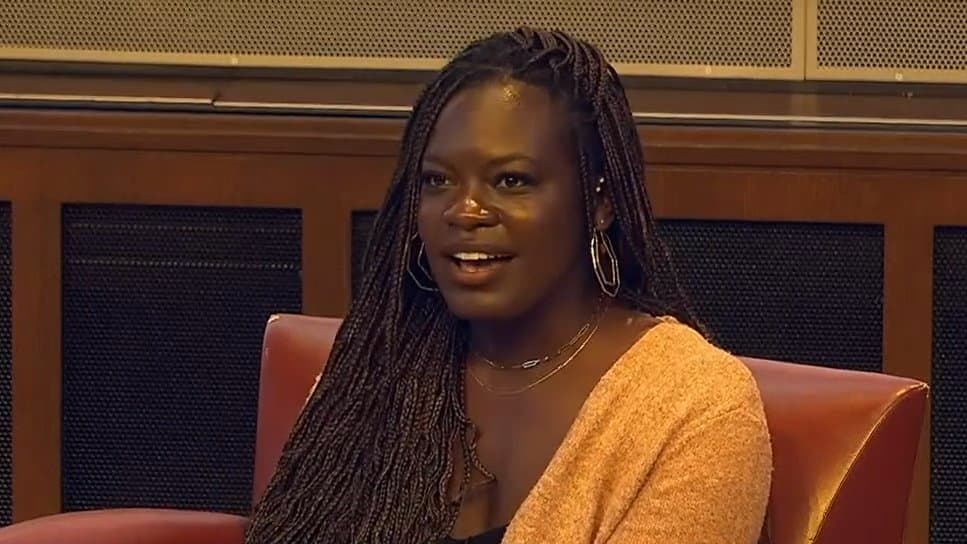
Baxter tells the audience in McCosh 50 about a young girl who didn't know a scientist could wear a pink dress. Photo: Princeton University video
Dr. Raven Baxter opened Princeton University's Amplifying Voices Distinguished Lecture Series on Sept. 28, 2022. In McCosh 50, she spoke in a public conversation with Shawn Maxam, Princeton's associate provost for diversity and inclusion, then took audience questions.
Baxter told the audience about her first research poster. It was hot pink, with glitter, feathers and rhinestones. Her advisor told her to make a plain version or skip the symposium. She took the pink one.
Graduate students and postdoctoral researchers in the Natural Sciences chose her in a nomination and vote held in fall 2021. Craig B. Arnold, Princeton's vice dean for innovation, told the audience she was "way at the top of the list."
Her undergraduate research poster
"No matter how my poster was presented, the rigor of my work was still the same, the quality was still the same," Baxter said. At the symposium, dance, business and physical education majors lined up to ask about her senior-year project on soil microbial respiration. She won an award for her research at the event. Her advisor, she said later, had been trying to protect her.
"It's the little things that we do that can make a huge difference in how other people perceive science and scientists," she told the audience.
Asked where she finds the courage to be authentic, she said, "I don't think it should hurt anybody to be yourself." Later, an elementary school educator thanked her for giving children a positive image. Baxter answered with a story from a university talk in West Virginia. A little girl, lifted by her mother to reach the microphone, told her, "I didn't know that you could be a scientist and wear a pink dress."
"You just never know what resonates," Baxter said.
Training in science education
Baxter named her first science communication role model as Al Roker, "the weatherman on the Today Show." She asked, "What is fact without meaning? What is fact without understanding or connection?"
Moving from molecular biology into science education was "the hardest thing I've ever done in my life," she said. She already had a master's degree and industry experience. "I really truly did not actually know how to communicate science until I invested that time to research education," she said. Scientists, she said, should have some training in education.
Questions on trolls and trust
A climate scientist, a young woman of color, sent in a question on handling anti-science trolls on Twitter. In October 2021, a Nature survey of 321 scientists who had spoken to the media about COVID-19 found that 15% had received death threats.
"My role has always been that I don't return that energy," Baxter said. "Maybe I don't need to come into this conversation with the goal of persuading this person that I'm right. Maybe my goal is to just build trust." She described several conversations about COVID-19 vaccines with one hesitant person, starting with listening.
An audience member asked about "the global questioning of science." Baxter answered, "The challenge for many science communicators is being able to say I don't know or we don't know the answer to this yet." She added that "the United States government has a questionable history" with marginalized communities. "Acknowledging the history is really important for establishing trust," Maxam said. A Pew Research Center report that April found that three-quarters of Black Americans had heard of the Tuskegee syphilis study.
An audience member in McCosh 50 asks Baxter about the global questioning of science. Image: Princeton University video
Diversity in leadership
Baxter said she has often met with executive teams that bring her in to talk about diversity. "It's monochromatic and they're all men," she said. In her industry lab, almost all the scientists at the bench were women, but the senior scientists were men.
"If we're really wanting our efforts to serve the diversity of this world, we have to make sure the leaders of these efforts can represent the diversity of this world," she said. Later she added, "Scientists love data. The data supports a need for diversity."
Universities should listen to students, she said. "It's one thing to send messaging, but I think that there also needs to be actions."
Princeton's Amplifying Voices series
Princeton's Office of the Dean for Research announced the series on Sept. 23, 2021, as one of three cornerstones of its inclusion and equity action plan. The plan answered President Christopher L. Eisgruber's June 2020 charge to campus leaders to combat systemic racism.
Maxam, left, and Baxter on stage in McCosh 50. Photo courtesy of Dr. Raven Baxter
At the close, Maxam gave Baxter a personalized lab coat and joked that she could wear a pink dress underneath the coat. "I'm going to add rhinestones on here," she said.
Maxam presents Baxter with a personalized lab coat at the close of the evening. Image: Princeton University video
Baxter, known online as Dr. Raven the Science Maven, worked in drug discovery at Albany Molecular Research before teaching biology. Her doctorate, awarded by the University at Buffalo in February 2022, studied science communication through hip-hop. The day before, she joined a Harvard Belfer Center panel on outbreak communication.
Princeton University posted the full 82-minute recording on its YouTube channel. The event listing is on the website of Princeton's Office of the Dean for Research.
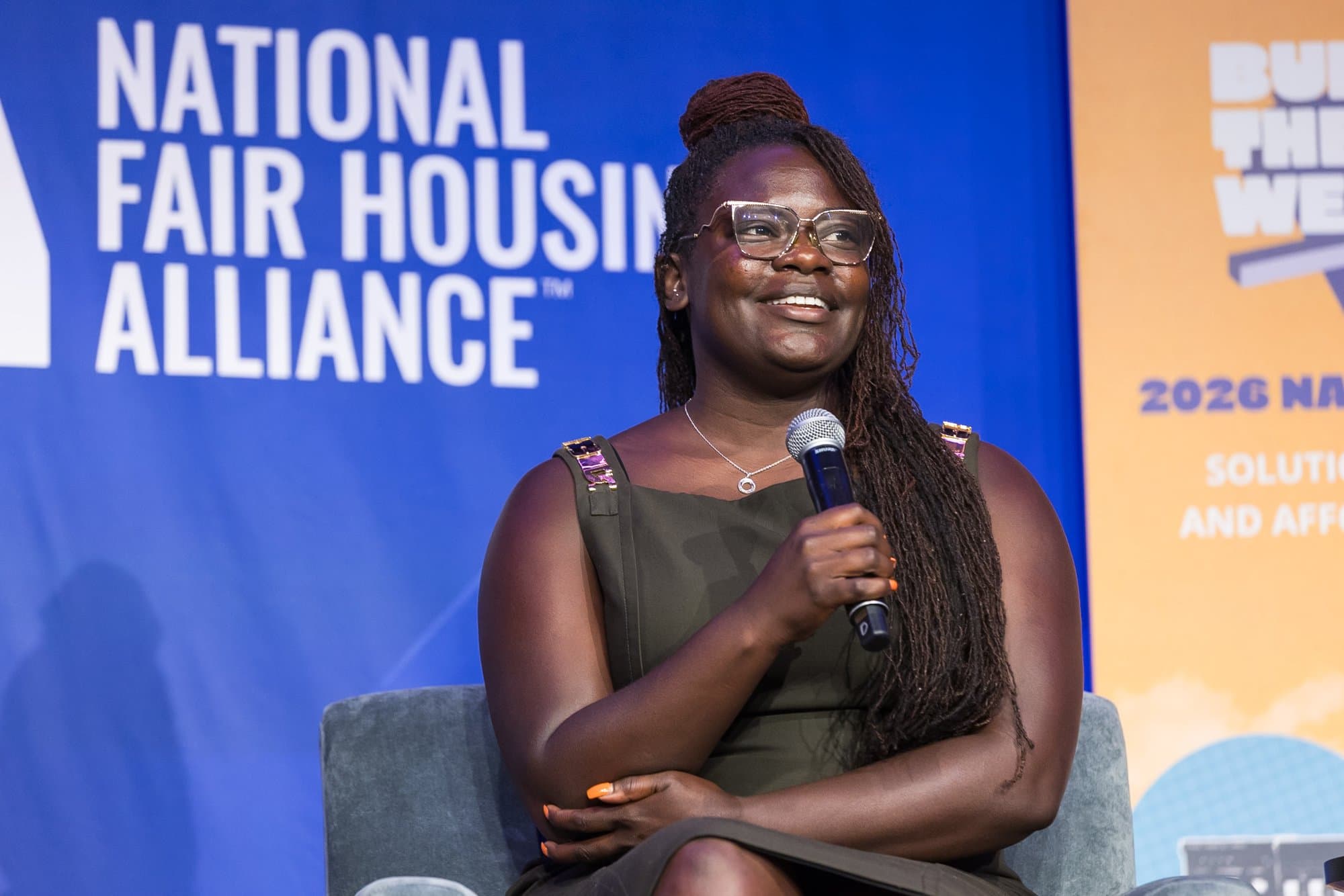
Dr. Raven Baxter joined National Fair Housing Alliance President and CEO Lisa Rice on June 28, 2026, for a fireside chat on housing discrimination at the alliance's national conference in Washington.
Dr. Raven Baxter joined three fellow University at Buffalo alumnae on the UB Distinguished Keynote Panel at the fourth annual WNY Leadership Summit on May 29, 2026.