Raven Baxter was the featured guest of the National Science & Technology Medals Foundation's STEM Spotlight series in an episode that premiered on YouTube on Dec. 3, 2020. Science journalist Sarah Williams interviewed her about diversity in science, her doctoral research and careers in science communication.
The foundation premiered the episode at a live YouTube watch party, where Baxter was billed to answer viewers' questions. It was the last STEM Spotlight episode of 2020.
"We need diversity if we want to do the best science that we possibly can," Baxter told Williams.
The episode aired as the public weighed a new vaccine. A day earlier, the United Kingdom's medicines regulator approved the Pfizer-BioNTech COVID-19 vaccine, the first COVID-19 vaccine cleared for use in the UK. The same day as the premiere, Pew Research Center reported that 60% of Americans would definitely or probably get a COVID-19 vaccine, up from 51% in September. That spring, a collective of 30 Black scientists and naturalists had launched Black Birders Week on social media after a racist incident in Central Park, Audubon magazine reported.
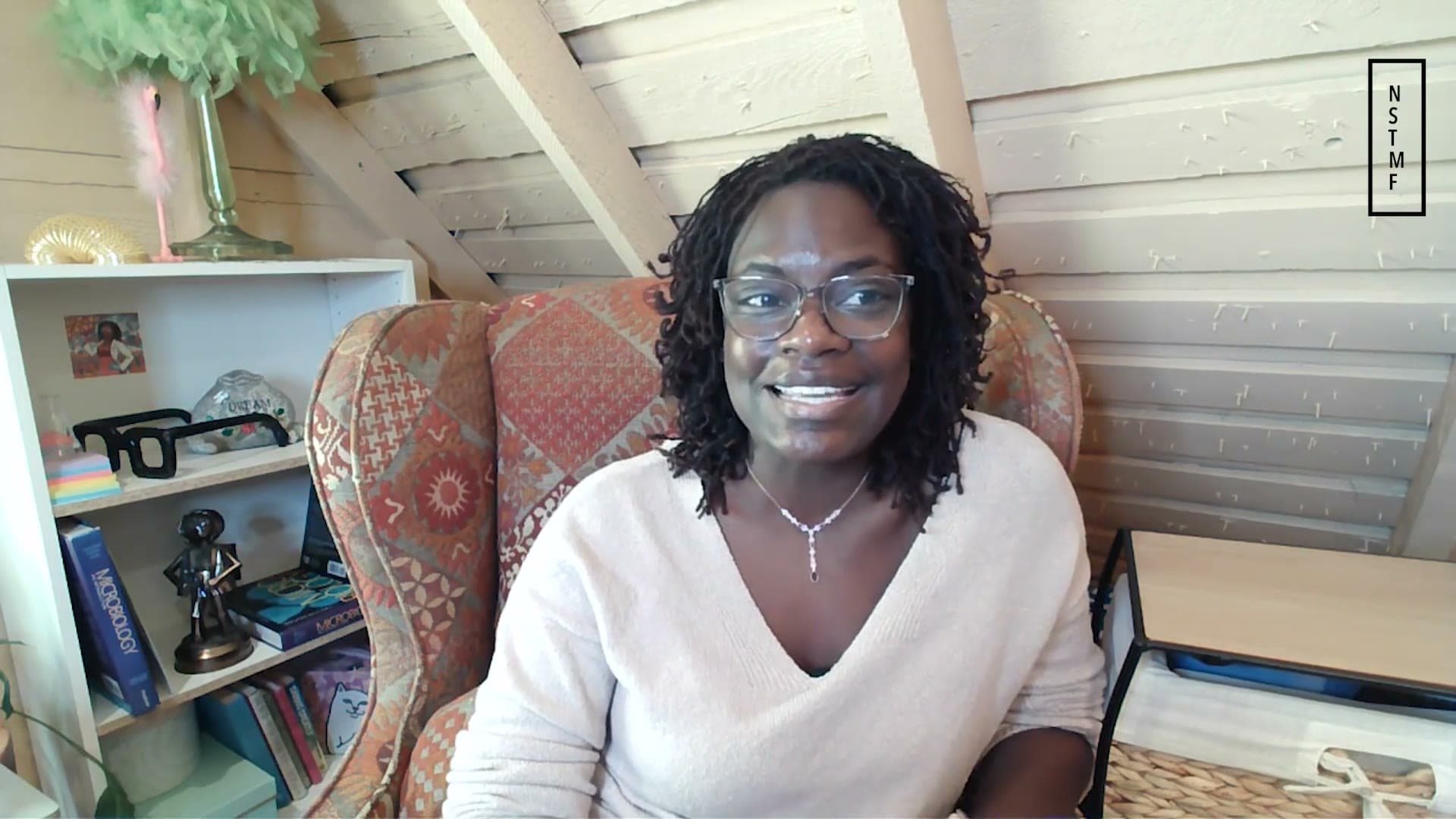
 Science journalist Sarah Williams, left, interviews Baxter for STEM Spotlight. Image: National Science & Technology Medals Foundation video
Science needs people who think differently
Williams raised Baxter's TEDx talk, "You Don't Look Like A Scientist!", and asked why it matters what scientists look like. Baxter said a field dedicated to answering questions and solving problems needs people with different life experiences.
"We're not going to get very far in science if we have people in the same room who are all the same," she said. She described walking into spaces where science was done or taught, where people assumed she did not belong based on her appearance. She uses music and creativity, she said, to break down ideas of what a scientist looks like.
Representation that reaches adults
Baxter, then finishing a Ph.D. in science education, described her dissertation research. It studied reactions to her music video Big Ole Geeks, which paired the look of a rap video with technical scientific lyrics. Her analysis focused on Black women, both in and outside STEM careers.
She highlighted one finding. Black women who did not choose STEM careers, including police officers and judges, responded strongly to the video. "They said that if they had the type of representation that I created in my music video when they were younger that they would have at least tried to pursue a STEM career," Baxter said.
Researchers who study gaps in STEM almost always study people already in STEM careers, she said. They very rarely ask adults why they did not choose STEM. Many women in her study said the video made them feel liberated. It showed, she said, that "you can basically be your unapologetic self and be anybody who you wanted to be but still be seen as competent."
Science and humanity in 2020
Williams asked about Black in Science Communication Week, which Baxter founded and which ran Oct. 4 to 10, 2020. Baxter said the pandemic, racial injustice and civil unrest had all heavily affected Black people that year.
"It becomes very difficult to balance your scientific voice with your voice for your own humanity," she said. Many Black science communicators were exhausted, she said, because they were working double time.
Room for research and community work
A biology Ph.D. program interviewed her three times, she said, then turned her down. "They did not accept me because I had an interest in science communication and science education," Baxter said. At the time she held a master's degree in biology and had two years of experience as a corporate research scientist.
She wants a future where a scientist can work in the lab in the morning and at a community center in the afternoon. She recalled her COVID-19 prevention music video, made the day after New York's stay-at-home order in March 2020. "My intention with that was just to calm everybody down," she said.
 The foundation's title card for the episode. Image: National Science & Technology Medals Foundation video
Many paths into science communication
Baxter told the series' student viewers that online video is one small piece of science communication. She listed science writing, science and medical illustration, patent law, museums and nature programs, and lobbying. "What SciComm looks like for you is not necessarily what it is for me," she said.
For students who feel alone in their fields, she recommended online support groups and affinity networks. "Keep telling yourself that you belong in the space," she said. "You do belong there. You deserve to be there. You've earned your spot to be there."
The foundation and its series
The National Science & Technology Medals Foundation was founded in 1990 by George B. Rathmann, the founding CEO of Amgen. It honors laureates of the National Medal of Science and the National Medal of Technology and Innovation, and connects them with students. Its stated mission is "to build inclusive STEM communities across the United States."
"There isn't one perfect path to success or one correct way to build a STEM career," the STEM Spotlight page says. Guests in 2020 included Afua Bruce, Jennifer Dionne, Mary Garcia-Cazarin, Nicki Washington and Priyanka Komala.
Baxter, a molecular biologist, was then working toward her Ph.D. at the University at Buffalo. Fortune had named her to its 40 Under 40 in health that year. She later taught scientists to build their brands with the foundation and NYU Langone.
The full 35-minute episode is on the foundation's YouTube channel.
https://www.youtube.com/watch?v=26vX94w8FSo