Raven Baxter spoke on How and When to Add Voices, a panel at the Rosalind Franklin Society's virtual year-end meeting, on Dec. 17, 2020. She joined Alexis Stutzman, a founder of #BlackInGenetics, in a conversation moderated by Julianna LeMieux of Genetic Engineering & Biotechnology News.
Baxter's main argument was about who stays in science. "I feel as though the inclusion and equity part is sometimes an afterthought," she said. "We get people in the door, they're here, and then people fail to realize that the work environment is not best suited for the people that they want to have work there."
The session aired six days after the FDA authorized the first COVID-19 vaccine for emergency use. In late November, Pew Research Center found that 60% of U.S. adults would get a vaccine. Among Black adults, the figure was 42%. The day before the panel aired, Science News profiled Baxter among five Black researchers fighting for equity in science.
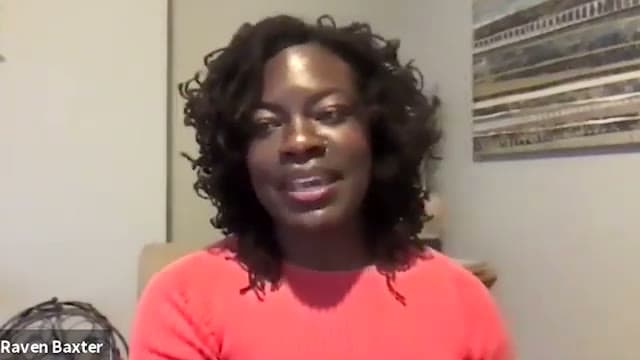
 Clockwise from top left, Karla Shepard Rubinger of the Rosalind Franklin Society, moderator Julianna LeMieux, Baxter and Alexis Stutzman. Image: Rosalind Franklin Society video
Retention over recruitment
Baxter said a lack of cultural and social awareness leaves people of color uncomfortable at work. Many end up tiptoeing around their colleagues, she said. "I feel like that's a big reason why it's hard to retain marginalized people in these environments," she said. That is why improving STEM culture is her focus.
LeMieux asked what each listener could do. Baxter said asking questions is one of the most powerful things a person can do. "I think that one of the best ways to approach diversity is with curiosity, rather than with any type of judgment," she said.
She urged listeners to take hard questions straight to department leaders. She offered one to ask. "I've noticed that in our department, we have all these claims to commitment to diversity but we can't keep a person of color in our department. What is going on?"
 Baxter urges people who fear speaking up to keep records and use their voices. Image: Rosalind Franklin Society video
For those afraid to speak up, she gave practical advice. "Document everything, get things in writing, document all of your experiences, follow up your conversations with emails," she said. She added that power structures are "created by man but we all come into this world equal."
Trust in a pandemic
Baxter tied Black mistrust of medicine to real harms. "And rightfully so, because of the tragedies that have occurred at the hands of the U.S. government," she said. Visibility matters for that reason, she argued. On social media, she said, people often tell her, "Wow, I've never seen a Black scientist before."
"We are really filling in a gap that desperately needed to be filled, especially in a pandemic, between science and the public, but particularly between marginalized people in the public and science," she said.
LeMieux then asked about calls to put Black communities and communities of color first for COVID-19 vaccines. In October, a National Academies framework had urged special efforts to deliver vaccine to high-vulnerability areas. It pointed to the CDC's Social Vulnerability Index, citing the virus's heavier toll on people of color.
Baxter disagreed with singling them out. She pointed to "generational trauma" in America's medical history. "If you target marginalized communities, even if it's for good intentions, it's not going to feel comfortable for a lot of people," she said. Stutzman suggested removing barriers to access instead, with vaccines at every grocery store and pharmacy.
Science literacy for every student
Asked what the incoming administration should do, Baxter said rebuilding trust starts in schools. "Every school, every student needs to have science literacy training," she said. "It must be a mandatory part of our curriculum."
She also looked back on the #BlackIn weeks that spread across Twitter in 2020. Three years earlier, as a molecular scientist in industry, she knew no other Black scientists in person. "I really wish that I had the community that has been created really this year in the Black In movements," she said. "It's extremely powerful for me to know that people who were once hidden are now coming into visibility."
 Baxter describes her move from an industry lab into science education. Image: Rosalind Franklin Society video
A society named for Rosalind Franklin
Publisher Mary Ann Liebert founded the Rosalind Franklin Society in 2007. Its founding board first met that April at The Rockefeller University. The society describes itself as an honorific, international group that recognizes and advances the contributions of women in the life sciences.
It is named for Rosalind Franklin, the X-ray crystallographer whose images of DNA were crucial to the discovery of its structure. The 2020 meeting, Labs, Leaders, and Critical Connections, was free and held online over two afternoons. LeMieux opened the session by noting that Franklin "would have turned 100 this year." Rita Colwell, the former director of the National Science Foundation, was the society's president.
Baxter was then a Ph.D. candidate at the University at Buffalo's Graduate School of Education. Two months earlier she had founded and co-organized the first Black in Science Communication Week, held online.
The Rosalind Franklin Society posted the full session on its YouTube channel. Baxter's panel runs through the first 41 minutes.
https://www.youtube.com/watch?v=Jf_ybxaWXKw