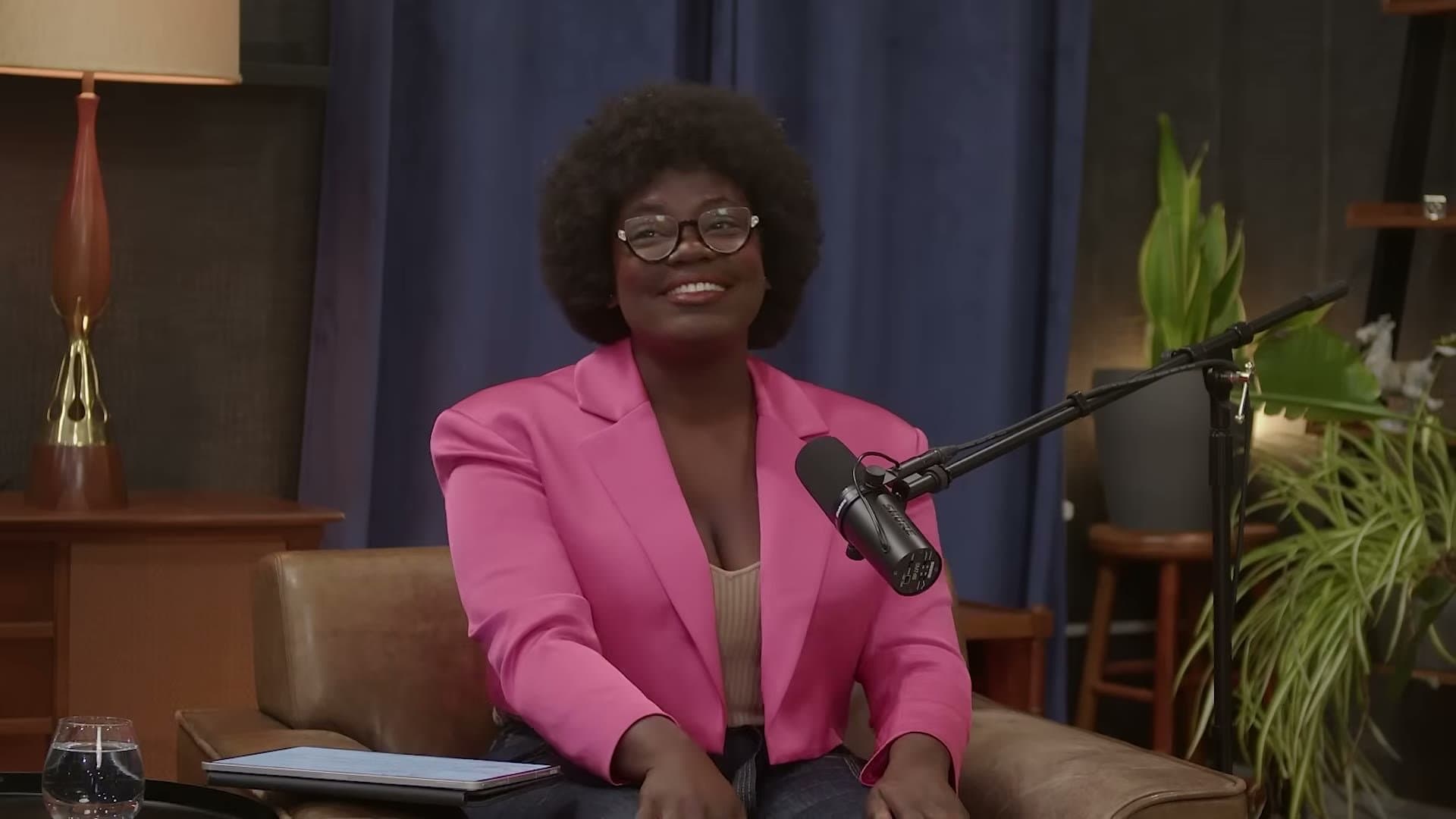
Dr. Raven Baxter hosted the sixth season of Pfizer's Science Will Win podcast, which launched on Feb. 19, 2026. Its five episodes on cancer ran through April 2, and Acast Creative Studios produced the season.
The first episode opened with her best friend. Dr. Marshall Anthony Jr., a social scientist and educator she has known since middle school, was diagnosed with colorectal cancer at 33 after losing his mother to colon cancer. Baxter told listeners she pushed him to keep his colonoscopy appointment and went with him to the hospital. "I knew that the only way to really understand what was going on was to get screened and I knew the earlier the better," she said.
"And even though I've worked in drug discovery and biomedical sciences, even though I know cancer is treatable, when it's your best friend, I really just couldn't make sense of that," she said. "And plus, we're so young."
 Baxter and Dr. Marshall Anthony Jr. record the season's first video conversation. Image: Pfizer video
On Jan. 13, the American Cancer Society reported that five-year survival for all cancers combined had reached 70% for the first time. On March 2, 11 days into the season, the society reported that colorectal cancer is rising 3% a year among adults 20 to 49. It is now the leading cause of cancer death in people under 50.
Talking about cancer
In a prologue released Feb. 17, Baxter framed the season around ending the silence. "Cancer looms large in our culture, and sometimes it feels too big to talk about. I get it. But silence can make it feel even scarier," she said. "Because when we talk about cancer, we take away some of its power."
"As a molecular biologist, I've actually worked on cancer drugs in the lab," she told listeners. "And honestly, if just one person decides to get screened after listening to this podcast, that would be worth it for me."
Young adults and screening
The first episode featured Dr. Yin Cao of Washington University in St. Louis, a co-lead of PROSPECT. The Cancer Grand Challenges team is studying why early-onset colorectal cancer is rising around the world. Baxter explained that the American Cancer Society lowered its recommended screening age for average-risk adults from 50 to 45 in 2018.
An oncologist on the episode described a young patient who hid her chemotherapy pump from her workplace. "I can't help but feel that this patient story reflects a broader society that's simply not designed for young people to navigate cancer," Baxter said.
 Baxter in the studio for the season's first episode. Image: Pfizer video
Biomarkers, women and survivorship
The second episode turned to precision medicine. "You can think of a biomarker as a tiny molecular indicator that informs doctors about what's driving a patient's cancer," Baxter said. Thanks to these clues, she explained, care has shifted from one-size-fits-all toward treatments matched to each person's biology. Her video guest, former nurse Kelly Huffman, learned at 49 that she had stage IV lung cancer. Biomarker testing showed her tumor was ALK-positive.
The third episode traced how women brought breast cancer into public view. Baxter's video guest, Katrina M. Johnson, was first diagnosed with breast cancer at 28 and has faced it three times.
The fourth covered survivorship. Five-year survival across all cancers in the U.S. was 50% in the 1970s, Baxter told listeners, and it is 70% today. Her guest Bob Riter was diagnosed with male breast cancer at 40, in 1996. "Success in cancer care can't be measured by survival alone. It has to include dignity, support, and the ability to live fully," she said.
AI in cancer care
The finale on April 2 asked how artificial intelligence could speed discoveries to patients. "We shouldn't treat AI in health care as a magic wand, nor fear it as a looming threat," Baxter said. "We should evaluate it the same way we evaluate any new technology or clinical intervention, rigorously, continuously, and transparently."
New tools, she said, must lift the burden on patients. "What matters is that they create clarity, agency, and time. Because in cancer care, time is life."
Video conversations and audience
Pfizer was founded in Brooklyn in 1849 by cousins Charles Pfizer and Charles Erhart, according to its history page. Its announcement of the season said Baxter "returns as our host." For the first time, the show added full-length video conversations led by Baxter on Pfizer's YouTube channel. The first four episodes each came with one.
 Baxter introduces the season's new video interviews. Image: Pfizer video
As of Oct. 7, 2026, the video with Johnson had about 665,000 views on YouTube, and the conversation with Anthony had more than 145,000. Pfizer later published articles drawn from the season on women and cancer and survivorship, each crediting "Host Dr. Raven Baxter."
According to Pfizer, Seasons 5 and 6 together passed 1.2 million downloads, and "The Alarming Rise of Early-onset Cancer" was the most downloaded episode of both seasons. The Season 6 video series passed 1.1 million views on YouTube, and the video with Johnson was the most watched. In March 2026, Season 6 reached No. 7 on the U.S. Life Sciences podcast chart and No. 88 in the broader Science category.
Baxter, a molecular biologist and science educator, worked in drug discovery before earning her Ph.D. at the University at Buffalo. She co-hosted the fifth season with NASA astrophysicist Dr. Ronald Gamble.
All episodes are on Pfizer's show page, Apple Podcasts and YouTube.
https://www.youtube.com/embed/C4La7P0z_xs
Paid partnership with Pfizer.